
Stefanos Vamiedakis
PhD candidate in History, University of Crete
Preliminary Remarks on Labour and Key Economic Statistics
The Metapolitefsi (post-dictatorship) period was marked by profound changes and shifts in the nature and social significance of labour as a social relationship, as well as in employment relations more specifically. At the same time, partly as a consequence of these changes, it is in some respects particularly difficult to examine the period 1974–1990 as a single, undifferentiated period. In the case of official statistical surveys and findings (ESYE, OAED, etc.), this problem also assumes a crucial methodological dimension. On the one hand, there is widespread scepticism regarding the overall reliability of these surveys, as a whole and over time, a situation that has continually fuelled political disputes over these issues. On the other hand, the fact that research methods also changed from the early 1980s onwards, as Greek services sought to align themselves with their European counterparts, makes it even more difficult to draw reliable and indisputable conclusions about Greece and to compare the country with other European states. (1) Taking these considerations in mind, and always exercising the necessary caution, we can briefly examine some of the main characteristics of labour in Greece during the 1970s and 1980s.
First, it is worth recalling that the main sources from which the bulk of the material is drawn are the “population censuses” and “labour force surveys” conducted by the National Statistical Service of Greece (ESYE), as well as data from the Manpower Employment Organisation (OAED). (2) These two organisations do not always employ the same criteria in their surveys, although many consider those conducted by ESYE to be more reliable.
According to the prevailing methodology, the total population is first measured, from which the so-called Economically Active Population (EAP) is derived. This category comprises men and women aged between 10 and 65. Other surveys use the term “labour force”, which is similar to, but not identical with, the concept of the “economically active population”. (3)
In any case, the fact that, at least during this period, definitions of key concepts varied between sources, countries and even agencies within the same country means that the relevant data must be used and presented with the utmost care and caution.
The fundamental post-war development in Greece was undoubtedly urbanisation. One consequence of this process was the rapid contraction of the agricultural sector of the economy and, correspondingly, of employment in that sector. (4) The rural exodus led to a development of historic significance: for the first time, the urban population exceeded the rural population as a proportion of the total in 1971. By 1981, the combined populations of Athens and Thessaloniki accounted for almost 50 per cent of the country’s total population. (5) The decline in agricultural employment remained a constant trend throughout the 1980s. (6)
According to official data, the Economically Active Population (EAP) as a proportion of the total population fell from 43.4 per cent in the 1960s to 37.5 per cent in the 1970s, representing an absolute decline of close to 10 per cent. (7) This trend was reversed in the 1980s, when the proportion returned to its 1961 level. (8) According to the Organisation for Economic Co-operation and Development (OECD), the EAP accounted for approximately 35 per cent of the population between 1973 and 1983, whereas in most European countries the figure exceeded 45 per cent. (9) Regardless of differences in the methods of calculation, the evidence suggests that the ratio of the labour force to the total population did indeed deteriorate between the 1960s and the 1980s. (10)
A key characteristic of the EAP was the relatively small share of wage and salaried employment, which did not exceed 50 per cent during the post-dictatorship period. By way of comparison, the corresponding proportion in Western economies remained consistently above 70 per cent during the same period, while in OECD countries it stood at between 80 and 90 per cent. (11) Meanwhile, agricultural employment in Greece continued to decline, while the category of “employers and self-employed” remained at broadly the same level. (12)
The proportion of wage and salaried employment was similarly low within individual economic sectors. Wage and salaried workers accounted for 71 per cent of employment in the secondary sector and 64 per cent in the tertiary sector, figures considerably below those recorded in the European Economic Community (EEC). (13)
This phenomenon is frequently identified as the defining characteristic of Greece’s employment structure, and it has persisted throughout the post-war period. The relative stability of this structure has even been described as a “unique phenomenon”. (14) This Greek “peculiarity”—namely, that more than half of the employed population worked outside wage and salaried employment—persisted even when Greece was compared with supposedly “similar” countries such as Spain, Portugal, Italy and Turkey. (15) The conclusion is that, despite rapid urbanisation and the rural exodus, wage and salaried employment did not come to dominate the Greek labour market as it did in other Western countries. In other words, there was no mass process of proletarianisation. Instead, the “petty-bourgeois” character of the economy, reflected in self-employment and the prevalence of small and very small businesses, demonstrated a strong capacity for survival and reproduction.
Wage and salaried employment had other distinctive characteristics. The state assumed an increasingly significant role as an employer, a trend that intensified particularly during the 1980s. According to ESYE data, the proportion of wage and salaried workers employed in the public sector rose substantially over time, from 17 per cent in 1971 to 27 per cent in 1981 and 32 per cent by the middle of the decade, in 1984. (16) Approximately 65 per cent of those employed in the public sector worked in the core public administration—ministries, public-law legal entities and local authorities—while the remainder worked in public utilities and state-owned banks. (17) Whether this development represented yet another “Greek peculiarity” or, conversely, indicated convergence with the corresponding proportions in advanced European economies was, and remains, a subject of political controversy.
Another significant development during the same period was the substantial entry of women into the labour market. According to ESYE population censuses, women’s share of the total labour force rose from approximately 27 per cent in 1971 to around 31 per cent in 1981, before apparently stabilising at between 34 and 36 per cent during the 1980s.
The picture that has emerged regarding the employment structure—based on the following typology: wage and salaried employees, employers, self-employed workers, and contributing unpaid family workers— in the early 1980s, varies to some extent depending on the agency conducting the survey. Nevertheless, the period appears to have been characterised by a decline in the proportion of employers, the persistence of self-employment and an increase in the proportion of wage and salaried employees. (18) It is almost certain that a substantial part of this increase resulted from the “rural exodus”.
The period under examination was also characterised by significant shifts in the distribution of employment across economic sectors and branches of activity. Apart from agriculture, whose decline has been described as “normal”—accounting for 53.8 per cent of employment in 1961, 40.5 per cent in 1971, 30.7 per cent in 1981 and 28.9 per cent in 1985—the secondary sector showed signs of stagnation or slight contraction, while the tertiary sector followed a sustained upward trajectory. Employment in the secondary sector rose from 19 per cent of total employment in 1961 to 29 per cent in 1981, but fell back to 27.4 per cent in 1985. Employment in the tertiary sector, by contrast, increased sharply: from 27.2 per cent in 1961 to 33.9 per cent in 1971, 40.3 per cent in 1981 and 43.7 per cent in 1985. (19)
Employment in manufacturing, in particular, appears to have stagnated during the 1980s, remaining at levels similar to those recorded previously. This development was undoubtedly associated with the corresponding stagnation in industrial production and the progressive process of de-industrialisation that began towards the end of the 1980s and continued thereafter.
The Greek labour force was distributed very unevenly across the three sectors of production, with an overrepresentation in the tertiary sector and much lower, almost equal proportions in the primary and secondary sectors. Some researchers regard the fact that employment growth was driven by the tertiary sector as evidence of convergence with OECD countries. (20) In any case, as the 1990s approached, the so-called “tertiarisation” of the economy became increasingly dominant.
At the same time, it should not be forgotten that the 1980s also saw the emergence of so-called “new forms of employment”: that is, forms of working outside the “traditional” framework of full-time, permanent employment under an open-ended contract within the formal labour market. These included, for example, part-time and temporary employment, involving fixed-term contracts or contracts for specific projects. It is worth recalling that part-time employment was not legally recognised until 1990. Statistical records throughout the period showed relatively low rates, at around 5 per cent of the labour force, approximately 70 per cent of whom were women. This may, however, have been related to the fact that part-time employment was, in effect, an illegal practice, giving employers and workers alike strong reasons not to declare it. It is worth noting that the corresponding figure in the EEC exceeded 13 per cent in 1985.
Unlike part-time employment, temporary employment was recorded more clearly and appears to have accounted for a substantial share of wage and salaried work and of employment more broadly. According to ESYE, in 1985 almost 10.5 per cent of the labour force was in temporary employment, that is, working under fixed-term contracts. (21) Among wage and salaried employees specifically, the proportion was almost twice as high, reaching 21.2 per cent. Towards the end of the 1980s, the proportion of workers employed on fixed-term contracts appears to have increased. According to a 1989 survey conducted by the Athens Labour Centre (EKA), based on a sample of 2,000 workers, 12 per cent were employed on fixed-term contracts. A substantial proportion of temporary employment was undoubtedly attributable to employment practices that had begun to prevail in the public sector after the restoration of democracy. (22)
From the late 1980s onwards, the reality of “new”, flexible employment relations began to be widely discussed in public. This debate reflected a broader perception that the post-war model of economic development was approaching its end across Europe, a perception that also found expression in discussions about the “end of full employment”. From the outset, the debate was closely linked to the phenomenon of unemployment, concern about which had already begun to intensify in 1979. Unemployment thus began to emerge as a significant issue in public debate towards the end of the 1970s. The turning point was 1979, when a decline in the rate of employment growth was first recorded.
Despite the methodological and other problems affecting the surveys, unemployment rates appear to have multiplied between the 1970s and the 1980s. The increase recorded after 1981 was particularly significant. (23) Youth and female unemployment emerged as the dominant characteristics of this trend, reflecting developments elsewhere in Europe. Another adverse development was the increase in the duration of unemployment, with a growing number of people experiencing long-term unemployment. This, however, was also a phenomenon observed across Western economies during the 1980s.
In any case, the overall rates are difficult to estimate accurately. According to the OECD, for example, official unemployment rates rose sharply from 2–2.5 per cent during the 1970s to approximately 8 per cent by the middle of the following decade, where they then stabilised. The causes of this sharp increase became the subject of competing interpretations, largely shaped by political and ideological considerations.
------------------------------------------------------
(1) Το 1982 οι στατιστικές υπηρεσίες της ΕΟΚ προσπάθησαν να ενοποιήσουν τις σχετικές στατιστικές απεικονίσεις υιοθετώντας τους ορισμούς του Διεθνούς Γραφείου Εργασίας για τις έννοιες «εργατικό δυναμικό», «απασχολούμενοι» και «άνεργοι», σε μια προσπάθεια να γίνονται οι έρευνες με βάση ορισμούς κοινής αποδοχής, ούτως ώστε να έχει κάποιο νόημα οι συγκρίσεις μεταξύ των χωρών. Στη συγκυρία αυτή άλλαξε και ο τρόπος υπολογισμών της ΕΣΥΕ.
(2) Και δευτερευόντως διεθνείς υπηρεσίες και οργανισμοί, όπως ο ΟΟΣΑ και η Eurostat.
(3) Ωστόσο, στις διεθνείς στατιστικές (π.χ. ΟΟΣΑ) ο «οικονομικά ενεργός πληθυσμός» («working population») ταυτίζεται με το «εργατικό δυναμικό» («labour force»).
(4) Σύμφωνα με την απογραφή του 1981, η απασχόληση στον αγροτικό τομέα βρισκόταν στο 27% περίπου της συνολικής, ενώ κατά την απογραφή του 1971 ήταν στο 40% περίπου.
(5) Βλ. ΚΜΕ, Ανεργία και απασχόληση στην Ελλάδα, Σύγχρονη Εποχή, Αθήνα, 1991, σ. 143-144.
(6) Βλ. OECD, Economic Survey of Greece, 1989/1990, σ. 23.
(7) Βλ. Θ. Θεοδώρου, «Η εργατική τάξη στην Ελλάδα» [μέρος Β], Εργασία, τχ. 2, 14/12/1984, σ. 17.
(8) Βλ. ό.π. Σύμφωνα με τον ΟΟΣΑ, η άνοδος της εργατικής δύναμης που παρατηρείται από τα μέσα της δεκαετίας του ’70 οφείλεται στη μείωση της εξωτερικής μετανάστευσης, βλ. OECD, Economic Survey of Greece, 1981/1982, σ. 10-12.
(9) Βλ. Κ. Τσουκαλάς, «Η δομή της απασχόλησης και το μικρομεσαίο θαύμα», Αντι, τχ. 260, 11/5/1984, σ. 22.
(10) Σύμφωνα με την ΕΣΥΕ το ποσοστό του εργατικού δυναμικού στο σύνολο του πληθυσμού μειώνεται από 43,4% το 1961 σε 39% το 1986, βλ. σχετικό πίνακα 1, Κ. Κιουλάφας-Λ. Ζάραγκας, Ευρωπαϊκή ενοποίηση και αγορά εργασίας, σελ. 249 και σχετικό πίνακα 1, ΚΜΕ, Ανεργία και απασχόληση στην Ελλάδα, σελ. 142.
(11) Βλ. Θ. Θεοδώρου, «Η εργατική τάξη στην Ελλάδα» [μέρος Β], σ. 17-19.
(12) Βλ. Σ. Θεοδωρόπουλος, «Η εκμετάλλευση του ανθρώπου από τον άνθρωπο αλα ελληνικά», Οικονομικός Ταχυδρόμος, τχ. 27, 7/7/1988, σ. 24-25.
(13) Τα στοιχεία αφορούν το 1986-1987, βλ. σχετικούς πίνακες 9 και 10, ΚΜΕ, Ανεργία και απασχόληση στην Ελλάδα, σ. 154-155.
(14) Βλ. Κ. Τσουκαλάς, «Η δομή της απασχόλησης και το μικρομεσαίο θαύμα», σ. 22. Βλ. επίσης Θ. Θεοδώρου, «Η εργατική τάξη στην Ελλάδα» [μέρος Β], σ. 17-19.
(15) Βλ. σχετικό πίνακα 3, Κ. Τσουκαλάς, «Η δομή της απασχόλησης και το μικρομεσαίο θαύμα», σ. 21. Στοιχεία ΟΟΣΑ.
(16) Βλ. Π. Παπαδόπουλος, «Μερικές νέες εξελίξεις στη σύνθεση της ελληνικής εργατικής τάξης», Κομμουνιστική Επιθεώρηση, τχ. 12, Δεκέμβρης 1986, σ. 27.
(17) Βλ. Σ. Μαγκλιβέρας, Ο κρατικός τομέας της οικονομίας στην Ελλάδα και η κρίση, σ. 211-212.
(18) Ο ΟΟΣΑ εκτιμά ότι οι αυτοαπασχολούμενοι αποτελούν το 1/3 του συνολικού μη αγροτικού εργατικού δυναμικού και αποδίδει την άνοδο της αυτοαπασχόλησης στην εξάπλωση του τουρισμού και του τομέα των υπηρεσιών, βλ. OECD, Ecomonic Survey of Greece, 1979, σ. 12-13.
(19) Στοιχεία ΕΣΥΕ, βλ. σχετικό πίνακα 7, Κ. Κιουλάφας-Λ. Ζάραγκας, Ευρωπαϊκή ενοποίηση και αγορά εργασίας, σ. 251. Ο ΟΟΣΑ αναφέρεται σε «ραγδαία» αύξηση της απασχόλησης στις υπηρεσίες και την αποδίδει στο δημόσιο τομέα και τις τράπεζες, βλ. OECD, Economic Survey of Greece, 1985/1986, σ. 111-12.
(20) Βλ. ΚΕΠΕ, Απασχόληση-Ανεργία, σ. 33-34.
(21) Βλ. σχετικό πίνακα 6, Λ. Σμαΐλης, «Σύνδεση αμοιβής με παραγωγικότητα ζητά η πλειοψηφία των εργαζομένων», σ. 83.
(22) Σύμφωνα με τον ΟΟΣΑ, μετά το 1975 αυξάνονταν ραγδαία σε ετήσια βάση οι δημόσιοι υπάλληλοι χωρίς μονιμότητα, καταλαμβάνοντας ένα όλο και μεγαλύτερο μερίδιο στη συνολικότερη αύξηση της δημόσιας απασχόλησης, βλ. OECD, Economic Survey of Greece, 1981/1982, σ. 43.
(23) Κρίνεται σκόπιμο να επαναληφθεί η επισήμανση ότι μετά το 1981 οι έρευνες εργατικού δυναμικού περιλαμβάνουν και τον αγροτικό χώρο-πληθυσμό. Ο ΟΟΣΑ εκτιμά ότι από το 1979 παρουσιάζεται σημαντική αύξηση στην ανεργία, σχολιάζοντας παράλληλα ότι υφίσταται δυσκολία στον ακριβή υπολογισμό της, βλ. OECD, Economic Survey of Greece, 1981/1982, σ. 19-20.
The Evolution of the System of Labour Relations and the Labour Movement
1974-1981
The fall of the Dictatorship and the transition to a democratic regime took place within a relatively short period of time and also gave impetus to the labour movement. This process, however, did not follow a linear path towards “democratisation”. The period 1974–1981 was a phase of intense internal conflicts and realignments within the trade union movement. First of all, the movement remained deeply divided, as the official (“institutional”) trade union movement (GSEE, federations and Labour Centres) was separated from a significant and particularly militant section of organised and unorganised workers and employees, who either did not feel represented by the officially recognised representative bodies or, against their will, remained outside them.
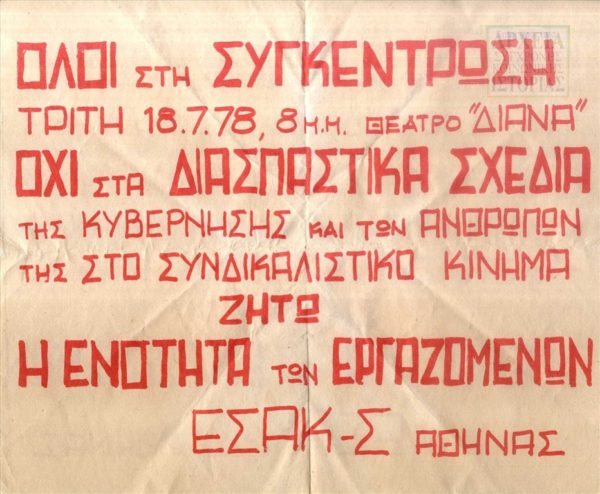
As the first years following the fall of the Dictatorship ushered in a new era of intense politicisation and class-based labour struggles, the emergence of a young, militant industrial working class with no previous trade union experience had a distinctly liberating effect. This took place within an environment of widespread radicalisation across many strata of Greek society (students, workers, etc.), creating new conditions.
As far as the official trade union movement was concerned, the process of “purging” it of individuals and practices associated with the dictatorship was carried out through highly cautious, yet also controversial, measures. The New Democracy government proceeded immediately with certain changes aimed at gaining control over the leadership of the trade union movement (the governing bodies of GSEE, Labour Centres and Federations).
At the legislative level, the fundamental labour, trade union and strike rights enshrined in the new Constitution of 1975 were supplemented and further specified through a series of legislative acts intended to achieve what was known as the “de-juntification” (apochountopoiisi) of the trade union movement. Through these measures, an attempt was made to restore democratic conditions with regard to trade union freedoms, elections and the reactivation of unions that had been dissolved under the dictatorship, through the appointment of new governing boards, among other measures.
Legislative Decree 42/74 abolished the labour legislation introduced during the period 1967–1974. As a result, the governing boards of the higher-level organisations (Labour Centres and Federations) and of GSEE were dismissed (although the governing boards of primary-level unions were exempted), and in September 1974 a new provisional administration took over at GSEE (24). The subsequent Law 6/75 annulled the governing boards of primary-level unions that had been elected during the dictatorship and established procedures for holding elections in trade unions at all levels.
These measures met with widespread opposition from the Left and from organisations and unions that had previously been excluded or struck off, on the grounds that they did not cover all organisations, did not require the amendment of their statutes (which dated from the Civil War or the junta period), and did not lead to their reinstatement as members of the relevant secondary-level organisations.
Throughout this period, the demand for the reactivation and reinstatement of unions was accompanied by various initiatives, including coordination and joint action among organisations, open assemblies, the submission of demands and memoranda to political, governmental and trade union bodies, and the publication of articles, among other activities (25). Numerous unions had begun to reconstitute themselves, enrol new members and seek reinstatement in their respective secondary-level organisations (26).
On this issue, the relevant legislative provision, which was eventually introduced in July 1975 (Law 89/1975), provided, among other things, for the restoration of legal-entity status to unions dissolved by the junta; regulated the return of movable and immovable property and archives; and established provisions concerning the appointment of provisional governing boards and deadlines for holding elections. On the other hand, the system of state funding for trade union organisations remained essentially unchanged, apart from certain largely cosmetic amendments introduced by Law 678/77.
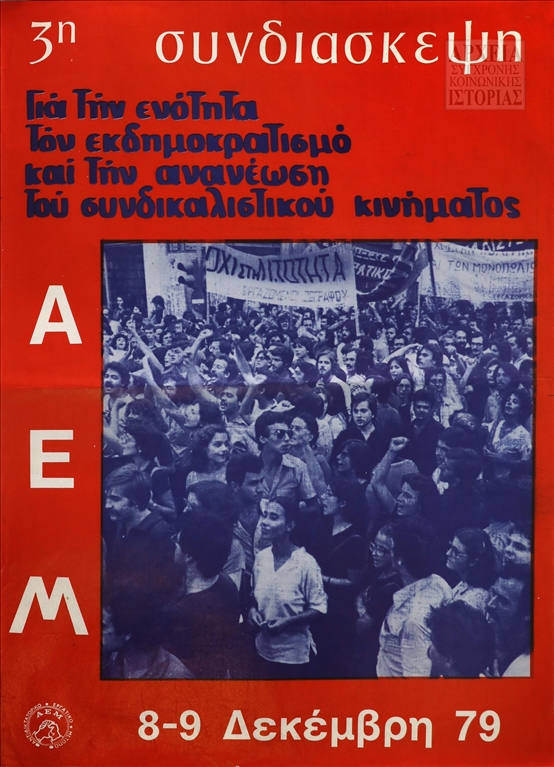
Thus, by the end of the 1970s, the situation within the official trade union movement hadn’t changed considerably compared with the past: state control over GSEE, the financial dependence of trade union organisations on the Ministry of Labour, a lack of mass membership and representativeness, and the fragmentation of workers’ unions. Throughout this period, the trade union forces operating “outside the walls” (ESAK, AEM and PASKE) acted jointly and in informal coordination as a “democratic opposition”, exerting pressure at both trade union and political levels for changes aimed at consolidating and expanding the process of so-called “democratisation”.
Alongside these struggles, the same period also witnessed the emergence of a new type of trade unionism: factory-based or enterprise-level unionism. This began to take shape as a movement in its own right immediately after the fall of the dictatorship. It primarily gave expression to an industrial proletariat that was, to a considerable extent, newly formed, as a result of the expansion of industry in the preceding decades (27). This was a “new” proletariat not only in terms of age, but also in the sense that it included large numbers of people entering factory employment for the first time (former farmers, young women, students, etc.).
The principal vehicle of factory-based unionism was the factory-level or enterprise-level union or committee. This was a model that took shape and sought to establish a role for itself for the first time in the immediate aftermath of the Metapolitefsi. The factory union brought together workers at the workplace, without internal distinctions (that is, regardless of their position, specialisation, etc.), thereby breaking with the traditional or conventional model of organisation based on occupational or sectoral affiliation.
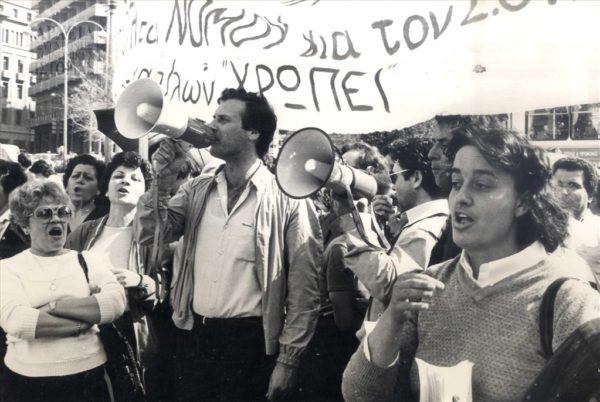
This new form of organisation spread rapidly, with the result that factory unions and committees took the lead in the wave of “wildcat strikes” between 1975 and 1978. During the movement’s peak years (1974–1979), it is estimated to have led to 132 strikes across 97 factories, many of which lasted for more than three weeks.
At the same time, of course, its militancy provoked a violent reaction from both the state and employers. The adoption in 1976 of a new law on trade union organisations (Law 330/76, “On Occupational Associations and Unions and the Safeguarding of Trade Union Freedom”) was clearly intended to criminalise, weaken and suppress this movement in particular. Under Law 330/76, strikes could be called only by legally constituted unions; so-called “unofficial” or “unauthorised” strikes were prohibited, as were “political strikes” and “solidarity strikes”. The right to act as a strike-breaker was protected, and, for the first time, employers were granted the right to declare a lockout. Meanwhile, occupying workplaces during a strike was treated as a criminal offence.
The law provoked intense opposition from the political opposition, expressed through strikes, mass protest marches and clashes with the police.
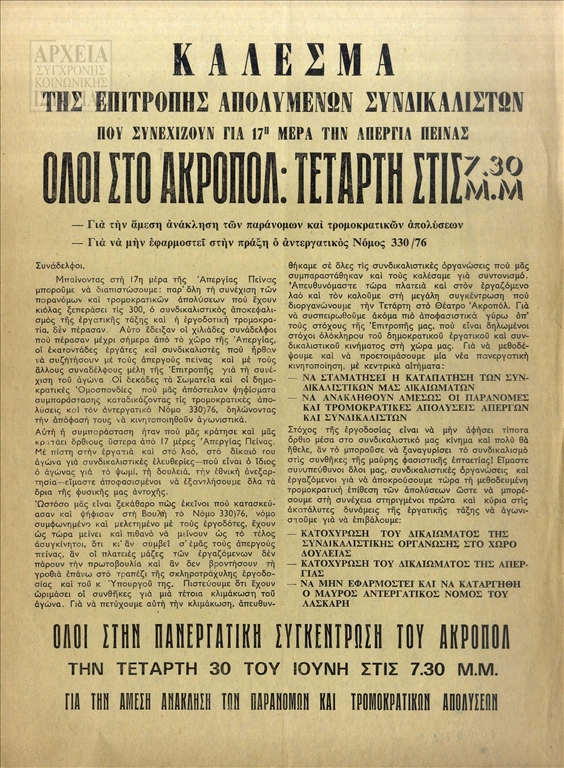
The implementation of Law 330/76 ultimately dealt a significant blow to factory-based trade unionism, through a wave of dismissals that followed its adoption (28).
For their part, the unions sought to defend themselves through greater solidarity and organisational consolidation. In 1979, six factory unions (29) established the Federation of Industrial and Employees’ Unions (OBES). In the period that followed, OBES brought together additional industrial unions and, at the height of its influence in the mid-1980s, had more than 160 affiliated unions.
To sum up, factory-based trade unionism was a movement that combined workers’ protest, experimentation, organisation and collective demands, ultimately giving expression to these new proletarian strata. It played a decisive role in revitalising the Greek labour and trade union movement, introducing new forms of organisation and struggle and securing victories that helped strengthen working-class confidence (wage increases, workplace democracy, the reinstatement of dismissed workers, etc.). It also advanced the demand for democratisation both within the workplaces themselves and within the structures of the official trade union movement.
------------------------------------------------------
(24) Στην ηγεσία της ΓΣΕΕ τοποθετήθηκαν στελέχη που προέρχονταν από τον κεντρώο-δημοκρατικό χώρο της προδικτατορικής περιόδου.
(25) Βλ. εφ. Ριζοσπάστης, 3.1.1975, 13.3.1975, 14.3.1975, 21.3.1975, 23.3.1975, 23.10.1975, 24.10.1975, 25.10.1975, 6.11.1975, 11.11.1975
(26) Βλ. εφ. Ριζοσπάστης, 25.1.1975, 18.2.1975, 22.2.1975, 8.3.1975, 12.3.1975, 4.4.1975, 8.4.1975, 17.6.1975, 20.6.1975, 27.6.1975, 7.9.1975.
(27) Από τα μέσα της δεκαετίας του 1960 αρχίζει και η δημιουργία μεγάλων βιομηχανικών ζωνών στα κυριότερα αστικά κέντρα της Ελλάδας (Αθήνα, Πειραιάς, Θεσ/νίκη, Πάτρα). Στα 1978 πια, ο τομέας της μεταποίησης απασχολεί πάνω από μισό εκατομμύριο εργάτες, ενώ 220.000 περίπου από αυτούς εργάζονται σε 751 μονάδες άνω των 100 ατόμων. Βλ. σχετικά Χρήστος Ιωάννου, «Η Βιομηχανική Εργατική Τάξη στο Συνδικαλιστικό Κίνημα 1974-1984», στο Κοινωνικές Τάξεις, Κοινωνική Αλλαγή και Οικονομική Ανάπτυξη στη Μεσόγειο, Διεθνές Συνέδριο του Ιδρύματος Μεσογειακών Αλλαγών, Ίδρυμα Μεσογειακών Μελετών, Αθήνα, 1984, τ. Α΄, σ. 37.
(28) Υπολογίζεται ότι οι απολύσεις απεργών και μελών εργοστασιακών σωματείων ή επιτροπών ξεπέρασαν τις 10.000 μέχρι και το 1981. Βουλευτές του ΚΚΕ υπολόγιζαν τον αριθμό των απολύσεων σε 13-15 χιλιάδες περίπου για την περίοδο 1975-1980, ενώ υπουργός του ΠΑΣΟΚ ανέφερε ένα σύνολο 12.500 απολύσεων στα 1974-1981. Άλλοι ερευνητές (Χρ. Ιωάννου, «Η βιομηχανική εργατική τάξη στο συνδικαλιστικό κίνημα 1974-1984», στο Διεθνές Συνέδριο του Ιδρύματος Μεσογειακών Μελετών, Κοινωνικές τάξεις, κοινωνικής αλλαγή και οικονομική ανάπτυξη στη Μεσόγειο, σ. 46) υπολογίζουν σε 15.000 τους απολυμένους εργάτες μεταξύ 1976-1981. Από την άλλη, κάποιοι από τους πρωταγωνιστές ανεβάζουν τον αριθμό των απολυμένων σε πάνω από 30.000, συνυπολογίζοντας και το γεγονός πως κάποιοι από τους συνδικαλιστές εργαζόμενους απολύονταν 2 και 3 φορές.
1981-1989
The rise of PASOK to power in October 1981 triggered a chain of developments and ushered in a climate of optimism, euphoria and expectation. It also consolidated and entrenched the hegemony of its trade union arm (PASKE) within the trade union movement. In this context, the demands for “democratisation” and “workers’ participation” became the cornerstones of PASOK’s labour policy and its central ideological and political unifying elements.
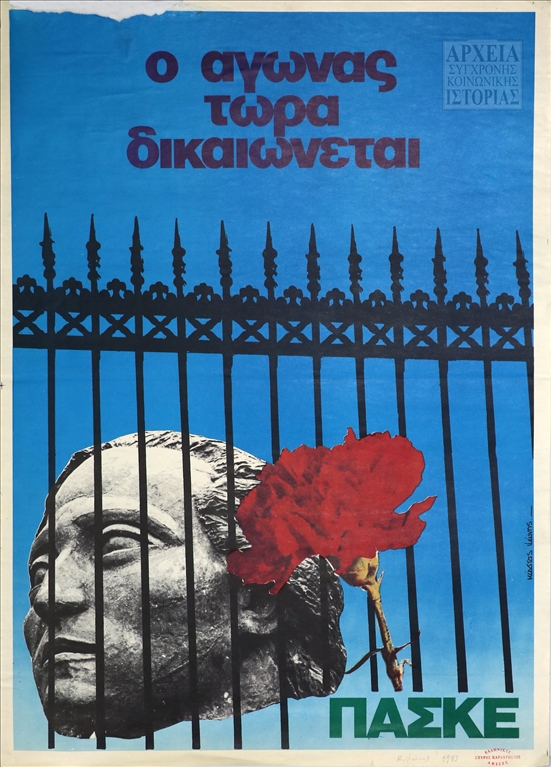
The labour policy initially pursued was based on a generous incomes policy towards low-paid workers and pensioners receiving low pensions, as well as on an attempt to bring about a comprehensive and radical revision of the post-Civil War legal framework concerning workplaces and the structures of the trade union movement. This effort was framed in terms of “democratisation” and found its legislative expression in Law 1264/82 (30).
Law 1264/82 laid the foundations for the introduction and consolidation of democratic and participatory procedures, both within the trade union movement and in the workplace. Initially known as the “anti-330” law, it was presented as the vehicle through which the overwhelming majority of organised and unaffiliated trade union forces, which for decades had been marginalised and excluded from official trade union structures, could secure their place. Indeed, following the adoption of Law 1264/82, an unprecedented process of mobilisation was set in motion, which over time led to the almost complete control of trade union organisations by the forces described as “democratic”.
At the same time, the same law provided workers and their representatives with the legal means and protection necessary to ensure their unimpeded presence, intervention and activity in the workplace. Thus, beyond the “opening up” and “democratisation” of official trade union organisations, the aim was also to dismantle the established practices within production sites, curb employer arbitrariness and establish rules and limits governing relations between capital and labour.
When, in 1983, the scope for continuing the incomes policy was deemed economically unsustainable, the main focus of government intervention in the field of industrial relations shifted towards so-called “institutional” reforms, which established significant institutions and procedures that were unprecedented in the Greek context.
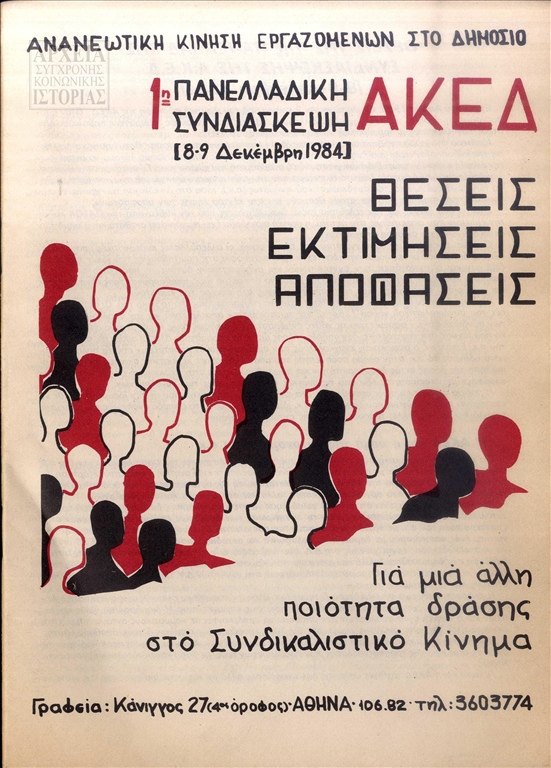
Thus, the parallel demand for “workers’ participation”, alongside that for “democratisation”, was pursued during the same period through a package of related legislative measures. Through Laws 1385/83 (“On Supervisory Councils in the Mining and Quarrying Sector”), 1387/83 (“Control of Collective Dismissals”) and 1365/83 (“Socialisation of Public-Sector and Public-Utility Enterprises”), the government sought to introduce a series of institutions and procedures that would strengthen workers’ representation in both the public and private sectors. Underlying these legislative measures was the intention to grant organised workers’ representatives an enhanced role and greater powers in matters relating to their everyday working lives and experience.
The aim was for workers to (re)appropriate the labour process through their participation in a system of consultation that would make them, to some extent, jointly responsible for working conditions, the organisation of production, the product, and so forth. At the same time, the government hoped that this approach would “mitigate” class conflict or, at the very least, channel it into more closely regulated arenas, supervised and controlled by mixed bodies comprising representatives of the state, employers, workers and other social actors (local government, etc.). These arrangements (“institutions of participation”) were either decentralised or centralised in character; some had relatively small memberships, while others brought together a wide range of organisations and individuals. Their powers were generally limited and advisory in nature, although there were also cases in which they were vested with decision-making authority.
Of particular importance was also the adoption of the law establishing formal equality between men and women in industrial relations (Law 1414/84). To a considerable extent, this legislation resulted from an effort to bring Greek law into line with the provisions of the conventions arising from Greece’s membership of the EEC on this issue. It sought to rectify a regime of unequal treatment between the sexes, including in terms of pay, which had characterised working conditions in Greece for decades.
Towards the end of the decade, Law 1767/88 was adopted (31). This law ratified the now well-known International Labour Organisation Convention No. 135 (“Protection of Workers’ Representatives in the Undertaking and Facilities to Be Afforded to Them”), which had been adopted by the International Labour Organisation in 1971 and whose ratification by Greece had remained pending for more than a decade. At the same time, the law provided for the establishment and operation of a novel institution within private-sector enterprises employing more than 50 workers: Workers’ Councils. These councils were established to facilitate consultation between employers and employees on a range of issues relating to industrial relations and the operation of the enterprise.
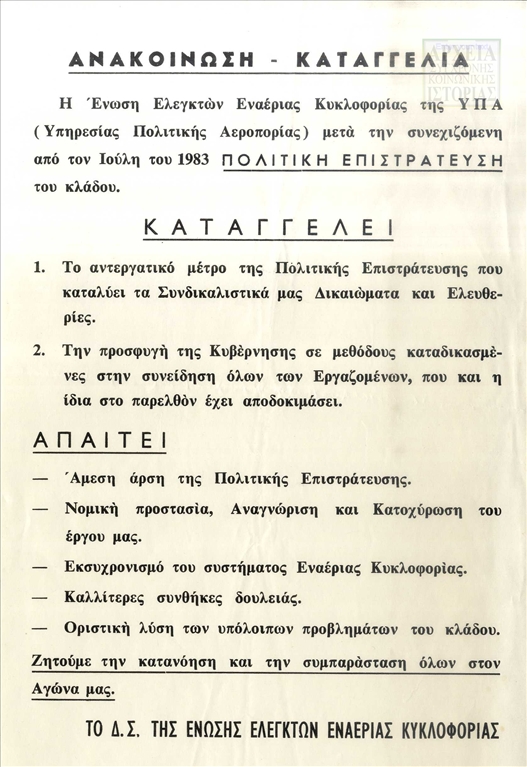
With Law 1767/88, the process of introducing institutions of “workers’ participation” into the Greek system of industrial relations was completed. These institutions brought about significant changes to the institutional framework governing industrial relations in Greece, although their actual implementation remained extremely limited, according to a survey conducted by the Ministry of Labour in 1995 (32).
Nevertheless, these efforts, although supported by a large section of the workforce, were not equally successful in every instance, nor were they without controversy. In the case, for example, of the law on “socialisation” (Law 1365/83), a fierce dispute erupted over the notorious “Article 4” (33). This put at risk the hitherto conciliatory stance adopted by part of PASOK’s labour and trade union base, while also triggering the definitive breakdown of its fragile “alliance” with the other forces of the Left.
From the outset, Article 4 was characterised as “anti-strike”, and a wave of strikes broke out, creating a major problem for the government and leading to a complete rupture in its relations with the Communist Party of Greece (KKE). The same controversy also triggered the first crisis within the ranks of GSEE’s appointed “democratic” leadership. GSEE president O. Chatzivasileiou resigned from his post, and was subsequently followed by five other members belonging to ESAK-S (the KKE’s trade union arm) (34).
This crisis within GSEE had wider repercussions for the trade union movement, as it developed into an explicitly political confrontation between PASKE and ESAK-S. In turn, this marked the definitive end of a period during which relations between the two camps had been characterised by a willingness to coexist and even cooperate (35).
------------------------------------------------------
(29) ΠΙΤΣΟΣ, ΕΒΙΟΠ-ΤΕΜΠΟ Αιγάλεω, ΕΒΙΟΠ-ΤΕΜΠΟ Χαλκίδας, Βαμβακουργίας Μαρτίνου, Οινοποιείο ΚΑΜΠΑΣ και ΒΙΣ.
(30) «Για τον εκδημοκρατισμό του Συνδικαλιστικού Κινήματος και την κατοχύρωση των συνδικαλιστικών ελευθεριών των εργαζομένων». Υπήρξε με άλλα λόγια ο νόμος που αντικατέστησε τον 330/76 της Νέας Δημοκρατίας.
(31) «Συμβούλια εργαζομένων και άλλες εργατικές διατάξεις – Κύρωση της 135 διεθνούς σύμβασης εργασίας».
(32) Σύμφωνα με αυτήν, από τις 6.441 επιχειρήσεις που θα μπορούσαν να έχουν Συμβούλια Εργαζομένων, λειτουργούσαν τέτοια μόνο σε 126 (2%), εκ των οποίων η πλειονότητα υπολειτουργούσε, βλ. Γ. Ρωμανιάς, «Τα συμβούλια εργαζομένων και η ελληνική εμπειρία», Ενημέρωση, τχ. 55, Ιανουάριος 2000, σελ. 11-12.
(33) Το άρθρο αυτό ρύθμιζε το καθεστώς για την κήρυξη απεργίας στις «κοινωνικοποιημένες» επιχειρήσεις. Εκεί προβλεπόταν ένα ειδικό πλαίσιο: ένα σωματείο θα μπορούσε να κηρύξει απεργία μόνο στην περίπτωση που η πρόταση αυτή θα συγκέντρωνε την απόλυτη πλειοψηφία (50+1%) επί του συνόλου των εγγεγραμμένων μελών του, σε αντίθεση με όσα ίσχυαν μέχρι τότε (απλή πλειοψηφία επί των παρισταμένων στη γενική συνέλευση).
(34) Βλ. Καθημερινή, 29/5/1983, Το Βήμα, 29/5/1983, Ριζοσπάστης, 29/5/1983, 31/5/1983. Απόφαση υπέρ του νομοσχεδίου έλαβε και η Εκτελεστική Επιτροπή της ΑΔΕΔΥ.
(35) Η κρίση αυτή θα κορυφωθεί και θα λάβει οριστικό χαρακτήρα το φθινόπωρο-χειμώνα του1985, όταν με αφορμή τα νέα οικονομικά μέτρα του ΠΑΣΟΚ η διοίκηση της ΓΣΣΕ θα γίνει αντικείμενο δικαστικής διαμάχης και η ΠΑΣΚΕ θα διασπαστεί με τη δημιουργία ενός νέου συνδικαλιστικού-πολιτικού φορέα (ΣΣΕΚ).
Collective Bargaining during the Metapolitefsi, 1974–1990
The Greek system of labour relations was traditionally characterised by a high degree of centralisation, state control and paternalism. A key manifestation of this situation was the way in which the system of collective bargaining between employers and employees, leading to the conclusion of so-called Collective Labour Agreements (CLAs), had been structured (36).
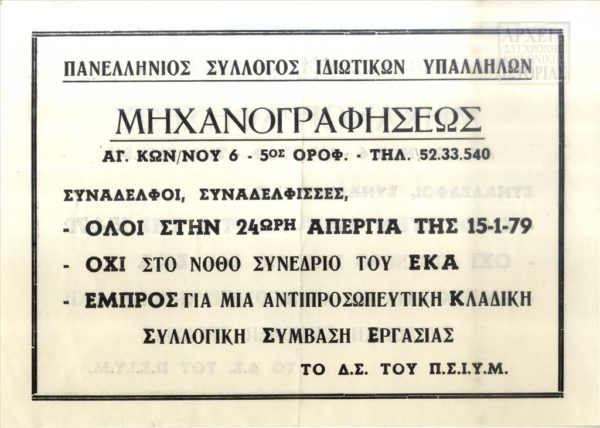
In Greece, the framework within which collective bargaining took place was determined by the post-war Law 3239/1955, “On the Regulation of Collective Labour Disputes, etc.” This was a regulatory framework that reflected the mutual distrust and conflict between wage labour and employers in the aftermath of the Civil War, thereby establishing the state and its agencies as the general supervisors and regulators of labour relations.
In essence, the legislative framework established by Law 3239/55 allowed the state to unilaterally determine the price of labour power. The original provisions of Law 3239 granted extensive powers to representatives of political authority, and particularly to the Ministry of Labour, through which significant obstacles were imposed on the exercise of fundamental trade union rights (e.g. the right to strike). Despite the successive amendments and additions introduced in the years that followed (37), the philosophy, spirit and many provisions of the original law remained intact (state interventionism, the “institution” of compulsory arbitration, etc.).
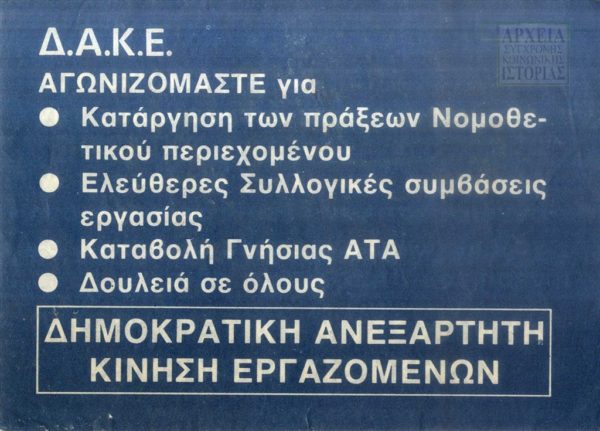
The democratic trade union movement regarded Law 3239/55 as one of the fundamental expressions of post-war state interventionism and paternalism. After the Metapolitefsi, the official trade union movement refrained from raising the issue of reforming or abolishing Law 3239/55, as priority had been given to internal organisational issues within the trade union movement. The Left, on the other hand, called for radical changes (such as the introduction of enterprise-level CLAs), while the principal demand that emerged was framed more generally as one for “free collective bargaining”, meaning the abolition of compulsory state arbitration.
From the late 1970s onwards, demands for a change to the institutional framework grew increasingly strong. Indeed, many aspects of collective bargaining practices changed during this decade, and new trends began to emerge (38). Law 3239/55 was now being openly denounced as anachronistic and anti-labour.
During PASOK’s first term in government, changes at the top of trade union organisations (“democratisation”) and the generous incomes policy kept demands for the abolition or amendment of Law 3239/55 relatively muted. This situation was also sustained by repeated assurances from the Ministry of Labour that a reform of the collective bargaining system was imminent.
From the mid-1980s onwards, the issue of Law 3239/55 remained in a state of continuous suspension and intermittent re-emergence, as the question of its revision was periodically brought back onto the agenda through government initiatives, public statements, and similar developments (39). Debate over the Greek collective bargaining system intensified towards the end of 1987, when the intention to amend Law 3239/55 was expressed even at the highest levels of government. The timing of this renewed public debate was not accidental, as the Stabilisation Programme was then being relaxed to the point of abandonment. Nevertheless, the pre-election climate and the political polarisation of the period prevented any further progress beyond the publication of a relevant draft bill.
Ultimately, the law replacing 3239/55 was passed in early 1990, under the Ecumenical Government. The new Law 1876/90 (“Free Collective Bargaining and Other Provisions”) sought to establish collective bargaining as an autonomous process by limiting the role of the state in it. Its aim was to create in Greece a modern framework for “free bargaining”, in line with Western European models and international guidelines (40).
Under Law 1876/90, enterprise-level CLAs were also recognised. The scope of collective agreements was thus extended to cover the entire field of labour relations (41). The abolition of compulsory arbitration was accompanied by the establishment of a new, specialised and independent body, the “Organisation for Mediation and Arbitration”, specifically tasked with mediation and arbitration in order to facilitate an agreement between the two parties (42). Nevertheless, despite the institutionalisation of a series of stages in the free bargaining process, there were also provisions that significantly restricted this possibility (43). During the following decade, the regulation of issues relating to the collective bargaining system became a regular occurrence, through successive legislative interventions, amendments, and other measures.
------------------------------------------------------
(36) Οι ΣΣΕ αποτελούν τη βασική «συμφωνία» που συνάπτεται μεταξύ των επίσημων, οργανωμένων φορέων εκπροσώπησης της κάθε πλευράς και περιλαμβάνει, πρωταρχικά, τον καθορισμό της τιμής πώλησης της εργατικής δύναμης με τη μορφή του καθορισμού των επιπέδων μισθών και ημερομισθίων, αλλά και άλλες πλευρές που αφορούν την εργασιακή-παραγωγική διαδικασία (χρόνος εργασίας, επιδόματα, θεσμικά).
(37) Ν.Δ. 3755/57, Ν.Δ. 186/69, Ν.Δ. 73/74.
(38) Π.χ. το περιεχόμενό τους διευρύνεται με ζητήματα πέρα από τα μισθολογικά και εμφανίζονται για πρώτη φορά ΣΣΕ σε μεμονωμένες επιχειρήσεις με τη μορφή των «άτυπων συμφώνων». Βλ. Γ. Κραβαρίτου-Μανιτάκη, Η συμμετοχή των εργαζομένων στις ελληνικές επιχειρήσεις, σ. 78-80• Θ. Κατσανέβας, Εργασιακές σχέσεις στην Ελλάδα: Το θεσμικό πλαίσιο και οι συλλογικές διαπραγματεύσεις, ΚΕΠΕ, Αθήνα, 1983, σ. 159 και Κ. Μπακιρτζής, «Οι επιπτώσεις του ν. 3239 στο συνδικαλιστικό κίνημα», Εργασία, τχ. 2, 14/12/1984, σ. 53.
(39) Αυτό σχετίζεται και με τη διαμάχη γύρω από τον λεγόμενο «εκσυγχρονισμό» και την «απελευθέρωση» της αγοράς εργασίας που αρχίζει να αναδύεται στα 1985-1987, περίοδο εφαρμογής του Προγράμματος Σταθεροποίησης.
(40) Για το ν. 1876/90 βλ. Γ. Κουζής, «Το συνδικαλιστικό κίνημα και οι συλλογικές συμβάσεις εργασίας στην Ελλάδα και στην Ευρώπη», σ. 285-292• Α. Μοσχονάς, «Ελληνικό συνδικαλιστικό κίνημα και ευρωπαϊκή ολοκλήρωση», σ. 805-807• Γ. Σπυρόπουλος, Εργασιακές σχέσεις. Εξελίξεις στην Ελλάδα, την Ευρώπη και τον διεθνή χώρο, σ. 70-77.
(41) Π.χ. και για την κατ’ οίκον εργασία (άρθρο 1, παρ. 2).
(42) Βλ. και την ιστοσελίδα του ΟΜΕΔ, www.omed.gr.
(43) Σε περιπτώσεις π.χ. που αφορούσαν τη συλλογική διαπραγμάτευση στις ΔΕΚΟ, ο νόμος άφηνε περιθώρια που θα μπορούσαν να οδηγήσουν σε μορφές υποχρεωτικής διαιτησίας, βλ. ν. 1876/90, άρθρο 16, παρ. 1, εδ. Δ.
(44) Βλ. την έκδοση του ΟΜΕΔ με την κωδικοποίηση του πλαισίου, Θεσμικό πλαίσιο συλλογικών διαπραγματεύσεων, μεσολάβησης και διαιτησίας, wwww.omed.gr.
Tools

