

Christos Tsakas Assistant Professor of Economic History, Ionian University
The 1974 Event
The Third Hellenic Republic emerged from a multifaceted political, economic and national crisis. Despite the rapid transition to democracy and the avoidance of a Greek–Turkish war, the depth of the economic crisis revealed structural constraints and foreshadowed broader transformations. The partial recovery in growth rates and the temporary easing of oil prices after 1975 may have prolonged the life of Greece’s postwar growth model for a short while. They could not, however, conceal the fundamental problem: the conditions that had underpinned the “Greek economic miracle” had run their course. The 1973 oil crisis struck the Greek economy at a particularly inauspicious moment. The maintenance of high growth rates throughout that year, when monetary instability and inflationary pressures had already begun to emerge, was more a source of overheating than a sign of economic vigour.

The rapid industrialisation of the preceding decade had rested on the convergence of two decisive factors. On the one hand, the Association Agreement that Greece signed with the European Economic Community (EEC) in 1961 provided, in its initial phase, for the unilateral removal of Common Market tariffs on Greek industrial products (1). On the other hand, the political weakness of the labour movement and the absence of parliamentary scrutiny under the dictatorship allowed labour costs to be kept low. This went hand in hand with the reinforcement of non-tariff protection for Greek industry, which took the form primarily of generous investment and export incentives (2). Under this particular regime, Greek industry managed to attract foreign investment by serving as a gateway to the Common Market. It also succeeded in integrating its production processes vertically and diversifying its activities, while substantially increasing output and becoming more outward-oriented. In 1974, these two favourable conditions came definitively to an end. On the one hand, the timetable laid down in the Greece–EEC Association Agreement envisaged an acceleration, from the early 1970s onwards, in the dismantling of Greek tariffs on industrial imports from the Community. On the other hand, the release of pent-up social forces following the fall of the dictatorship led to an increase in labour costs, while the deterioration of public finances undermined the material foundations of Greece’s generous industrial policy. Moreover, the balance-of-payments pressures caused by the surge in oil prices were compounded by the increased burden of defence expenditure resulting from the crisis in Greek–Turkish relations (3).
Thus, 1974 was not merely a conventional political watershed. Rather, it constituted an event that inaugurated an entire period during which the Greek economy, in search of a new direction, was called upon to grapple with the problems bequeathed by the crisis of the postwar development model. Against this backdrop, the main challenges that emerged during this period concerned the adaptation of the growth model to the new conditions; the position and role of the Greek economy within the framework of European integration; the management of the radicalism unleashed by the transition to democracy; and the realignment of alliances within the social coalition in power.
------------------------------------------------------
(1) Industrial Development Organization, Greece and the Common Market, Athens, 1962
(2) T. Giannitsis, Η ένταξη στην Ευρωπαϊκή Κοινότητα και επιπτώσεις στη βιομηχανία και στο εξωτερικό εμπόριο [Accession to the European Community and Its Impact on Industry and Foreign Trade], Athens: Foundation for Mediterranean Studies, 1988, pp. 78–81, and G. H. Katsos–N. I. Spanakis, Industrial Protection and Integration, Athens: KEPE, 1983, pp. 55–92.
(3) K. Svolopoulos (ed.), Κωνσταντίνος Καραμανλής: Αρχείο, γεγονότα και κείμενα, 12 τ. [Konstantinos Karamanlis: Archives, Events, and Texts, 12 vols.], Athens: Konstantinos Karamanlis Foundation and Athens Publishing, 1992–97, vol. 8, pp. 69–75.
The Challenges
Industrial activity had been the driving force behind Greece’s postwar economic growth, centred on the exploitation of available raw materials and the attraction of investment in the production of intermediate goods and certain categories of capital goods. Greek industrialisation, however, never succeeded in adopting an export-led development model. Unable to develop a machinery-manufacturing sector, Greek industry relied almost entirely on imported machinery and equipment, thereby laying the foundations for an ever-widening trade deficit.
This model had already begun to reveal its limitations as Greek tariffs—and the corresponding customs revenues—were progressively reduced. Rising oil prices and defence expenditure subsequently made it increasingly unavoidable to finance the deficit through ever-growing inflows of foreign capital (4). The search for external resources, however, did not take place in a political or economic vacuum. On the one hand, the internationalisation of the Greek economy was closely bound up with the orientation of Greek industry towards the Common Market, which entailed corresponding commitments. On the other, the symbolic rupture in relations with the United States and the surge of anti-American sentiment in Greek society in the wake of the Cyprus crisis favoured the resolution of Greece’s financing needs within a Western European framework.
The strategy of rapid accession to the EEC largely reflected these aspirations. In the longer term, however, full membership of the Community entailed a further erosion of the protective framework surrounding Greek industry and, consequently, a deterioration in the trade balance. Despite the expected improvement in invisible receipts from tourism and shipping, assessing the implications of the Greek economy’s growing exposure to international competition would become an overriding priority in the years ahead. In this context, the wealth of economic analyses and studies produced by public institutions and private individuals on the eve of, and during the early years of, accession to the EEC constitutes in itself a phenomenon that calls for explanation. The findings concerning the impact of accession on Greek industry were used not merely as bargaining instruments to secure extensions of transitional arrangements and obtain exemptions from Community regulations. They also formed part of broader efforts to devise ways of adapting the Greek development model to the new conditions.

The new ideological, political, and socioeconomic environment, however, raised questions that went beyond the long-term orientation of the Greek economy. The course to be pursued also had to take account of the immediate pressures of a situation that remained highly fluid even towards the end of the 1970s. The restrictive economic policy adopted during the final phase of the dictatorship, combined with the surge in inflation that peaked after the outbreak of the oil crisis, had severely eroded the real incomes of wage earners. As a result, labour’s share of industrial output fell significantly in 1973, while real wages suffered a dramatic collapse during the first half of 1974.
These developments, together with the formal restoration of trade union freedoms and the broader political liberalisation ushered in by the return to parliamentary democracy, fuelled expectations of a fairer distribution of the social product. At the same time, however, these expectations threatened to undermine one of the Greek economy’s principal comparative advantages—low labour costs—at a moment when the entire postwar macroeconomic framework was being shaken.
This contradiction was constitutive of Greece’s post-1974 political order, as competing strategies for representing long-term capitalist interests took shape around it. In the early years following the transition to democracy, the need to consolidate the parliamentary regime necessitated a reduction in the rate of exploitation of industrial workers, both male and female, alongside the crushing of factory-based trade unionism (5). From the late 1970s onwards, however, the question of repression versus incorporation became central to the Right–Anti-Right divide that dominated political life, extending well beyond its political and ideological symbolism. At the same time, this question shaped the relationship between the dominant fractions of the social coalition in power and the bourgeois political parties representing the two competing strategies. Greek industrialists may have taken some time to recover from the shock of having to operate within a regulatory framework after the prolonged postwar period of virtually unrestricted freedom, accusing New Democracy of “socialmania” (6). Yet the developments that followed in the early 1980s were to give them a much sharper sense of proportion.
The democratisation of trade unionism (7), combined with the dramatic increase in the minimum wage under the first government of the “Change” era, dealt a severe blow to labour-intensive industrial enterprises, which had emerged as the major employers of the postwar economy. Entire industrial sectors, including textiles, shipbuilding, and mining, witnessed the collapse of their leading companies, as the change in political circumstances following PASOK’s rise to power and the further deterioration of the economic environment resulting from the second oil crisis made it impossible for them to continue their ever-expanding borrowing. Beyond the political challenge of managing the “troubled enterprises”, this development brought the trade deficit and the imbalance in the balance of payments into sharp focus. This was all the more significant given that rising incomes had also led to a substantial increase in the value of consumer imports. Moreover, for the first time in postwar Greek history, it generated a dynamic towards rising structural unemployment. This was a consequence of the failure to plan an alternative development path for the Greek economy, particularly under conditions in which migration flows were being reversed.

Despite the open conflict between the PASOK government and the Hellenic Federation of Enterprises (SEV), particularly with those industrialists directly affected by these developments, not all sectors and companies were impacted in the same way. The steel industry, which was experiencing severe difficulties in Western Europe, did not face comparable pressures in Greece—at least during the first half of the decade—from the international crisis affecting the sector (8). Meanwhile, the competitors of nationalised companies were objectively advantaged by the redistribution of market shares, particularly in cases such as the cement industry, where nationalisation was driven more by political considerations than by economic performance. At the same time, a number of companies operating in cutting-edge technology sectors, such as telecommunications and energy, began to emerge. By diversifying their activities, these companies would subsequently develop into corporate groups and form the core of Greece’s internationally competitive businesses in the 1990s.
Before this development became apparent, much later, it was not sufficient to alter the overall picture of the Greek economy during the 1980s. Another parallel process unfolding during this period, however, appears to have contributed in the longer term to partially offsetting the destruction of capital in the secondary sector of production. Adverse international conditions in merchant shipping, combined with political developments in major international shipping centres, had demonstrated to Greek shipowners the importance of maintaining stable bases that could serve as safe havens in times of crisis (9). The “repatriation” of shipowners’ capital became a key component in the accumulation of the conditions necessary for overcoming the prolonged stagnation of the 1980s, a development that went hand in hand with the ongoing tertiarisation of the Greek economy.
The growing importance of invisible receipts and net transfers from the EEC in financing the soaring trade deficit was insufficient to balance the current account. This structural inadequacy, periodically exacerbated by the electoral cycle and resulting in two severe crises in 1985 and 1989–1990, rapidly made borrowing a constitutive feature of the post-1974 development model. As a result, public debt soared from 27.2% of GDP in 1981 to 71.4% in 1990, making its management one of the central issues in the debate over the economic policies of the period.
------------------------------------------------------
(4) C. Tsakas, Οι έλληνες βιομήχανοι μπροστά στην ευρωπαϊκή πρόκληση [Greek Industrialists Facing the European Challenge], unpublished doctoral dissertation, University of Crete, 2015, pp. 194–218.
(5) On the institutional framework governing the suppression of factory-based trade unionism during this period, see C. Ioannou, Μισθωτή απασχόληση και συνδικαλισμός στην Ελλάδα [Wage Labour and Trade Unionism in Greece], Athens: Foundation for Mediterranean Studies, 1989, pp. 120–121.
(6) On the famous press conference through which SEV introduced the term into the political vocabulary of the period, see O Oikonomikos Tachydromos, 18 March 1976.
(7) S. Vamiedakis, Εργασιακές σχέσεις και συνδικαλιστικό κίνημα μετά τη Μεταπολίτευση: Η εργατική πολιτική του ΠΑΣΟΚ, 1981–1985 [Labour Relations and the Trade Union Movement after the Transition to Democracy: PASOK’s Labour Policy, 1981–1985], unpublished master’s thesis, University of Crete, 2009.
(8) T. Giannitsis, Η ένταξη στην Ευρωπαϊκή Κοινότητα και επιπτώσεις στη βιομηχανία και στο εξωτερικό εμπόριο [Accession to the European Community and Its Impact on Industry and Foreign Trade], Athens: Foundation for Mediterranean Studies, 1988, pp. 244–275; and D. A. Kazis and A. I. Vlasidis, The Steel Industry, Athens: KEPE, 1986.
(9) G. Theotokas and T. Charlafti, «Η ελληνόκτητη ναυτιλία. Διατήρηση και διεύρυνση της ηγετικής της θέσης» [“Greek-Owned Shipping: Maintaining and Expanding Its Leading Position”], in V. Panagiotopoulos (ed.), Ιστορία του νέου Ελληνισμού 1770–2000 [History of Modern Hellenism, 1770–2000], 10 vols., Athens: Ellinika Grammata, 2003, vol. 10, pp. 101–118.
“Socialmania” and Neoliberalism
The collapse of the dictatorship in the wake of the Cyprus tragedy appeared to the Greek bourgeoisie as a journey into uncharted waters. Within a few months, however, aided by the strong parliamentary majority secured in the November elections, political stability seemed to have been restored. In December, moreover, the referendum brought an end to the constitutional question that had long troubled the Greek political scene. The day after the referendum, the president of the Hellenic Federation of Enterprises (SEV), Dimitrios Marinopoulos, remarked at the annual meeting of the Union of Industries of the European Community (UNICE):
“It was a great stroke of luck that the change [...] took place peacefully and smoothly, without serious complications or problems. The possibility of such complications was naturally a source of fear, particularly for industrial leaders, given the extremely serious consequences that a violent overthrow of the dictatorial regime could have had for the country’s economic and social life.” (10)

The fact that SEV’s worst fears concerning the consequences of the transition to democracy had not materialised did not, however, imply that adjustment to the new circumstances would be smooth. Greek industrialists reluctantly accepted the first post-transition wage increases announced by the National Unity government, which were intended to partially compensate for the losses suffered by wage earners in 1973–1974 (11). When they realised, however, that these increases were only the beginning, their anxiety began to mount. In the years that followed, a form of trade unionism would emerge in their factories that differed markedly in style and ethos from the kind of unionism through which they had hitherto been accustomed to buying off their workers and maintaining control over them. Tensions escalated particularly when, in an attempt to redefine the relationship between the state and the major capitalists who had emerged as the dictatorship’s principal pillars of support, the first New Democracy government proceeded to nationalise the Emporiki Bank Group (12). SEV circles interpreted this move as a turn towards state interventionism that threatened the primacy of the private sector in the economy. In March 1976, they launched a fierce attack, denouncing what they called “socialmania”, while setting this tendency against the objective of convergence with the Common Market (13).
SEV’s reaction may not have immediately halted the state’s growing involvement in the economy, but it did accelerate another form of state intervention—one that industrialists welcomed: the tightening of the legal framework governing trade union activity and the suppression of labour mobilisations. This was a defining feature of the entire period up to 1981, even when accompanied by concessions in the form of spectacular wage increases amid a relative easing of inflation. The symbolic break with the tradition of nationalisation inaugurated by the first post-transition New Democracy government would come somewhat later. In 1977, SEV circles succeeded in securing the nomination, on the party’s electoral ticket, of Stefanos Manos, who came from the ranks of Greek industry. In May 1978, Konstantinos Mitsotakis’s entry into the government as Minister of Coordination was welcomed with relief—and enthusiasm—by advocates of private enterprise.
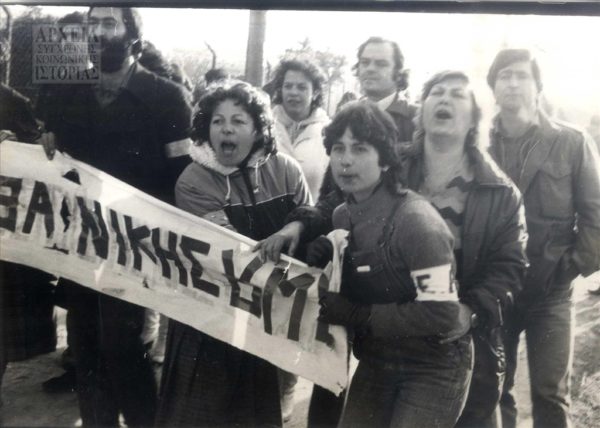
The May 1978 cabinet reshuffle brought to a close a period of intensive state intervention in the economy, during which several major contracts concluded under the dictatorship were renegotiated. That year also marked the completion of the dual strategy for managing the labour movement through a combination of wage concessions and the suppression of protest activity. From then on, the maintenance of the institutional framework directed against factory-based trade unionism would no longer be accompanied by wage increases sufficient to keep pace with the decade’s second inflationary surge. The definitive defeat of the factory committee movement, however, did not entail the complete triumph of the logic of social pacification. Instead, “wildcat” strikes would give way to a trade union movement of a more “parliamentary” character, which would favour breadth of participation and symbolic impact over intensity and duration. This movement, centred on banks and public utility companies, foreshadowed the growing importance of the forthcoming electoral contest amid economic instability and the retreat of labour mobilisation (14).
------------------------------------------------------
(10) SEV Bulletin, no. 299, 15 December 1974.
(11) SEV Bulletin, nos. 291–292, 31 August 1974, and no. 293, 15 September 1974.
(12) O Oikonomikos Tachydromos, 16 September 1976.
(13) SEV Bulletin, no. 382, 31 May 1978, and no. 384, 30 June 1978.
(14) C. Ioannou, Μισθωτή απασχόληση και συνδικαλισμός στην Ελλάδα [Wage Labour and Trade Unionism in Greece], Athens: Foundation for Mediterranean Studies, 1989, pp. 175–180.
From “Change” to Adaptation
By 1981, Greek industrialists’ accusations of “socialmania” seemed a distant memory. At the beginning of that year, Greece had formally become a full member of the EEC; the wave of nationalisations had subsided; factory-based trade unionism had been crushed; and the recovery of labour’s share of industrial output had been partially reversed. Against this background, the programme of the emerging alternative government was not confined to political symbolism. On the contrary, the historical bloc of “Change” advanced a clear political programme for incorporating the radicalism of the early post-transition period: a sharp increase in minimum daily wages, the democratisation of trade unionism, the reinstatement of nationalisation as an instrument of economic policy, and a redefinition of relations with the business community. In 1982, labour’s share of Greek industrial output exceeded its pre-dictatorship level for the first time, while in 1984 it reached a historic high, approaching—but remaining below—50%. Meanwhile, the PASOK government had already set in motion the nationalisation of AGET, one of the flagship companies of Greek industrialisation. It also secured the reinstatement of dismissed trade unionists in industries that had experienced major labour mobilisations and provided for labour representatives to participate in the management of private enterprises.

These initiatives, which gave rise to divisions along clearly defined class lines, nevertheless unfolded within the new regulatory framework established by Greece’s membership of the European Community. The rhetoric directed against this framework was not accompanied by any practical challenge to it, except insofar as it served as a bargaining instrument for extending transitional exemptions and securing additional compensatory measures. Moreover, the 1979 oil crisis, combined with the progressive dismantling of protectionism, significantly exacerbated the problems affecting the current account. The structural weaknesses of the productive system and the government’s social commitments made it impossible to address these problems through means other than domestic and foreign borrowing (15). This situation reached acute proportions during the 1985 election year, when the model of growth based on strengthening the domestic market revealed its limits: the value of imports increased by 26%, the trade deficit exceeded 15%, while, at the same time, labour’s share of GDP reached unprecedented levels in postwar Greek history.
Faced with these circumstances, the new PASOK government embarked on a dramatic shift in economic policy. By adopting a stabilisation programme supported by Community funding, it sought to tackle runaway inflation and bring public finances under control (16). The social cost of this shift, however, became immediately apparent. [ATA poster] In 1986, Greece experienced the sharpest decline in per capita earnings across the economy, as well as the steepest reduction in minimum daily wages up to that point in the country’s postwar history. In this context, labour’s share of industrial output fell to its lowest level since 1975. This policy continued into the following year, without, however, succeeding in reversing the structural weaknesses of the productive model. On the contrary, the 1986–1987 period marked the beginning of an accelerating expansion in expenditure on imports of capital goods and industrial consumer goods. Over these two years, the value of the latter exceeded that of the former by approximately 2.5 billion dollars. This trend was also reflected in developments in industrial exports: intermediate goods lost ground to consumer goods, while capital goods remained at consistently low levels.

------------------------------------------------------
(15) For an analysis of the Greek economy from this perspective, see S. V. Thomadakis, Κράτος και ανάπτυξη στην Ελλάδα. Ένα εξελικτικό δίδυμο [State and Development in Greece: An Evolutionary Duo], Athens: Alexandria, 2011.
(16) G. Pagoulatos, Greece’s New Political Economy: State, Finance and Growth from Postwar to EMU, New York: Palgrave Macmillan, 2003, pp. 103–114.
The Swan Song
Whatever positive fiscal results this policy may have produced were insufficient to convince the government of the need to continue austerity. Indeed, the governing party’s political representation was put to the test, as PASOK’s shift in economic policy generated secessionist tendencies within the movement’s trade union faction in the workplace. Beyond its political costs, however, the recessionary effects of austerity, combined with the failure to improve critical indicators such as labour productivity, also argued in favour of abandoning the policy shift. At the same time, against the backdrop of escalating political scandals, priorities began to change. Caught up in the Koskotas scandal (17), the government turned economic policy into an instrument of political survival. In this context, restrictive economic policy was completely reversed towards the end of the decade, with the aim of restoring PASOK’s political ties with the social groups that had borne the brunt of the fiscal adjustment undertaken in the aftermath of the 1985 elections. In the run-up to the repeated electoral contests, public finances followed a trajectory diametrically opposed to that of the 1986–1987 period.

The various policy experiments and reversals of the 1980s could not overcome the structural constraints of the Greek economy, which was called upon to address the social question under adverse economic conditions. By the end of the period, however, this contradiction had acquired a dynamic of its own. Having broken with the traditional actors of Greek economic activity, PASOK governments attempted, through controversial processes, to forge alliances with emerging business circles, using political support for the party as the principal criterion. This process, which ultimately fuelled conflicts of interest, stemmed from a twofold absence. On the one hand, there was no plan for an alternative organisation of the productive process based on new social relations. On the other, there was no alternative development model within the capitalist system itself. In this context, “Change” was reduced to redistributing available resources and, later—when the actual conditions of the economy could no longer sustain the cost of social policy—to imposing a coercive “adjustment” to economic reality. By the end of this trajectory, however, as so often happens in periods of disillusionment, political debate over the economy had inevitably narrowed to the defence or condemnation of the individuals who had assumed responsibility for managing it.
------------------------------------------------------
(17) On the political climate of the period, see G. Voulgaris, Η Ελλάδα της Μεταπολίτευσης, 1974–1990 [Greece in the Post-Junta Era, 1974–1990], Athens: Themelio, 2001.
Tools

