
Sotiris Rizas
Director of Research, Research Centre for Modern Greek History of the Academy of Athens
The European Vision and the Policy of Integration
Europeanism, as a general political orientation linked to the practical objective of joining the European Community, constituted the dominant narrative of the Greek bourgeois political establishment from the “Metapolitefsi” (the transition to democracy) onwards. Both the renewed conservative political camp, represented by New Democracy under Konstantinos Karamanlis, and the political formation that continued the tradition of the Centre, the Centre Union–New Forces, aligned themselves with this orientation. Two factors favoured the adoption of this strategy, one more long-term and the other more closely linked to the circumstances of the period.
In the context of the period, the loss of legitimacy of Greece’s participation in NATO imposed the European option as a fundamental strategic choice. The Cyprus crisis of 1974 represented the culmination of a twenty-year process during which Greek public opinion had come to regard it as an established fact that the United States and the Atlantic Alliance favoured Turkish interests at the expense of Greek interests, and that strategic considerations were given priority over the inalienable right of the Greek Cypriots to self-determination. The overthrow of Makarios by the Ioannidis dictatorship and the Turkish invasion that followed were regarded as part of a plan which, even if not dictated by the United States, was at least tolerated by Washington, with the ultimate objective of partitioning Cyprus. The resumption of the Turkish advance in Cyprus on 14 August 1974 constituted the final link in this long chain. Karamanlis, a quintessentially pro-Western politician, would withdraw Greece from NATO’s military command structure in an evident attempt to defuse public frustration and preserve the hard core of the post-war strategy of the bourgeois political establishment: participation, in the broadest sense, in the Western bloc.
Within this framework, the project of joining the European Community acquired paramount importance. In the first post-dictatorship elections of November 1974, this choice appeared to be endorsed by three-quarters of the electorate (New Democracy with 54.4 per cent and the Centre Union–New Forces with 20.4 per cent of the vote). Following the adoption and entry into force of the new Constitution on 11 June 1975, the Karamanlis government submitted an application for membership of the European Community.
12 June 1975: The Greek Government’s Application for Membership of the European Community
According to the architects of the policy, above all Karamanlis, membership initially signified political stability within a democratic framework; it was a strategy for consolidating democracy through external influence. Indeed, in contrast to NATO, which was associated with a realist, even cynical, pursuit of strategic interests, the European Community was certainly an economic organisation, but one that sought European integration on the basis of democratic principles and respect for individual and political rights.
A Greek Euroscepticism
The second elections of the post-dictatorship period, held in November 1977, revealed the existence of a strong current of public opinion that remained sceptical towards the European Community. It was Eurosceptic, to use the term that became established in Britain in the early 1990s. This current was expressed primarily by PASOK. The party’s leader, Andreas Papandreou, was an economist educated in the United States. His analysis was informed above all by the priority he attached to economic development, particularly by the question of how a relatively small and economically less developed economy could withstand the penetration of foreign products and embark on a path of development.
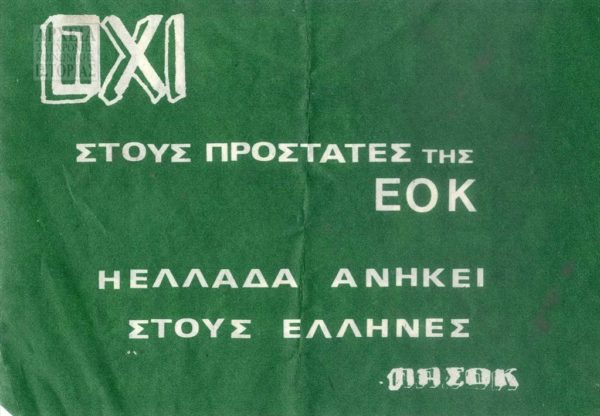
The second elections of the post-dictatorship period, held in November 1977, revealed the existence of a strong current of public opinion that remained sceptical towards the European Community. It was Eurosceptic, to use the term that became established in Britain in the early 1990s. This current was expressed primarily by PASOK. The party’s leader, Andreas Papandreou, was an economist educated in the United States. His analysis was informed above all by the priority he attached to economic development, particularly by the question of how a relatively small and economically less developed economy could withstand the penetration of foreign products and embark on a path of development.
As early as his first period of involvement in Greek politics, between 1964 and 1967, he had expressed reservations about the benefits of the Agreement of Association between Greece and the European Economic Community, which had been concluded by the conservative Karamanlis government and had entered into force on 1 November 1962. The exposure of Greek industry to European competition and the uncertain position of Greek agriculture were central concerns in Papandreou’s analysis. He attached particular importance to the development of strong national productive structures, which, during the stage of their formation, would need to be protected from external competition. During the post-dictatorship period, these reservations would intensify, as Papandreou’s analysis was now shaped by the historical experience of the 1967 coup and the seven-year dictatorship. His thinking evolved towards an acceptance of the neo-Marxist framework that divided the global economic system into a centre–periphery dichotomy. Papandreou also attached importance to political and economic aspects of the European Community that were absent from the concerns of the bourgeois political elites supporting membership. Thus, from a political perspective, the PASOK leader regarded the European Community as the economic arm of NATO.
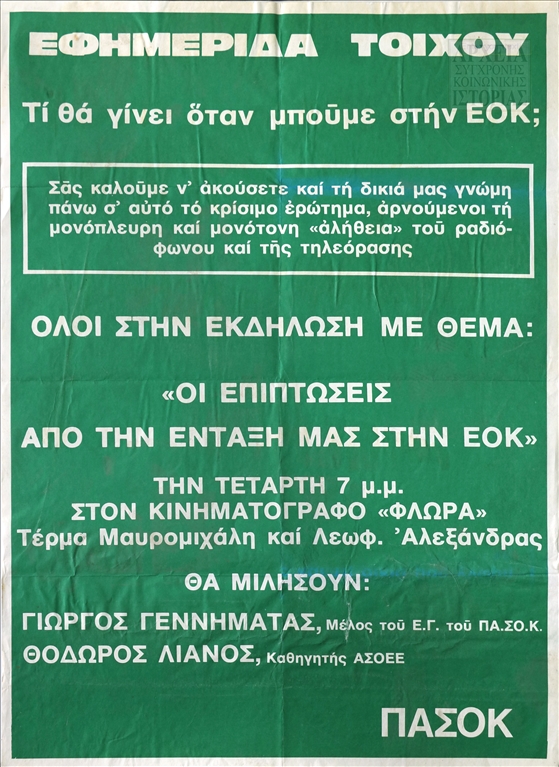
European social democracy in particular, by then identified with European integration, represented a vehicle for incorporating workers into the capitalist system, whose centre was the United States. Consequently, in contrast to Karamanlis’s geopolitical perspective and analysis, the European Community was not a vehicle for freeing Greece from American tutelage, but rather a means of binding it more closely to it. This position was encapsulated in the slogan of the period: “EEC and NATO, the same union.”
From an economic perspective, Papandreou emphasised that Greece was a country with a weak industrial sector, consisting largely of labour-intensive enterprises or, in any case, production units that did not rely on advanced technologies but were dependent on tariff protection. The gradual reduction of tariffs and their eventual elimination, as provided for in the Association Agreement in any event, would expose Greek industry to competition from the powerful manufacturing enterprises of Western Europe. Consequently, rather than serving as an agent of modernisation, the European Community would become an instrument for the contraction of Greek manufacturing.
Papandreou also questioned the benefits that the Common Agricultural Policy would bring to Greek agriculture. Although the actual effects of membership did not vindicate these particular reservations expressed by Papandreou during the second half of the 1970s, there were strong doubts in the Greek countryside about the benefits of membership. In reality, Papandreou and PASOK’s electoral campaign did not merely intensify or highlight these doubts; it gave them a political articulation.
20 November 1977: The ND’s Second Consecutive Victory, the Rise of PASOK and the Questioning of the Rationale for Accession
The election result altered the balance of power among the political parties. New Democracy was in decline (41.8% of the vote), partly as a result of the emergence of a far-right formation, but also because the electorate was becoming increasingly critical of its choices as memories of the dictatorship receded and democratic institutions became more firmly consolidated.
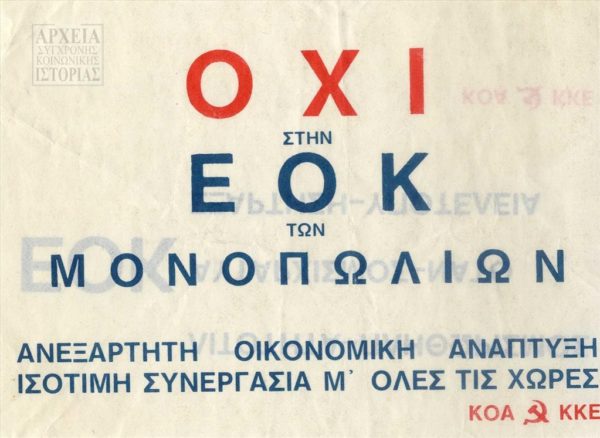 PASOK emerged as the second political force, winning 25.3% of the vote at the expense of the pro-European Union of the Democratic Centre (12%), while the Communist Party of Greece, which was also among the forces opposed to accession, secured 9.4% of the vote. Consequently, although it would not be entirely accurate to reduce the voters of each party to a simple pro- or anti-accession position, it cannot be overlooked that more than one-third of the electorate had voted for parties opposed to accession. Nor should it be overlooked that the political developments after 1978 further demonstrated PASOK’s emergence as a rising political force with a prospect of forming a government. It was within this political context that the question of accession would ultimately be decided.
Negotiations and the Accession Agreement
The negotiations entered their final stage from January 1978 onwards. The outcome of the Greek parliamentary elections contributed to this development, as the member states that supported Greece’s accession to the European Community for political and strategic reasons realised that the rise of PASOK was creating a new dynamic that could lead to the abandonment of the country’s integration if the negotiations were not concluded swiftly. At the same time, the Greek-Turkish dialogue, initiated at the highest level with the meeting between Karamanlis and Ecevit in Montreux, Switzerland, was contributing to a de-escalation in relations between the two countries. This was the context that led to the agreement on Greece’s accession in December 1978. The adjustment of Greek agriculture and the free movement of workers within the Community would be subject, in each case, to transitional periods of five or seven years.
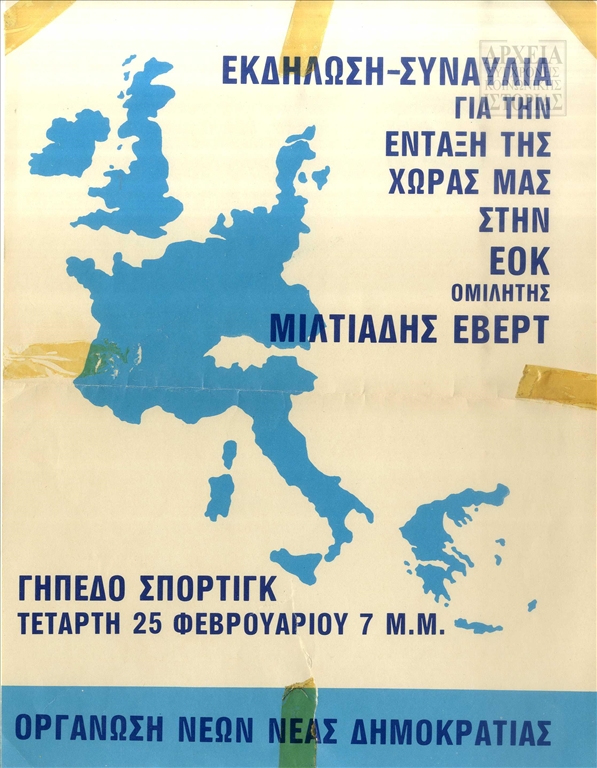
The accession negotiations were successfully concluded in December 1978, and the Treaty was signed in Athens in May 1979. The course of the negotiations from June 1975, when the application for accession was submitted, to the end of 1978 was complex and marked by significant fluctuations. Initially, the Greek application had to overcome reservations among the member states concerning Greek-Turkish relations. These centered on concerns that accession might bring the Greek-Turkish disputes into the framework of the European Community, as had previously occurred within NATO, when the 1974 Cyprus crisis had led Greece to withdraw from the military structure of the Atlantic Alliance. Concerns were also raised about Greece’s level of economic development, which lagged considerably behind that of the core Western European countries of the European Community. Furthermore, endemic political instability was a factor that caused some Community partners to express their hesitation, since the prospects for democracy could not yet be considered secure. Under these circumstances, the Commission of the Community, which was institutionally responsible for issuing an opinion before Greece’s application was considered by the member states, decided in January 1976 that, in view of these problems, a ten-year “pre-accession” period was necessary. The Commission’s decision was significantly influenced by the British Commissioner, Sir Christopher Soames, who evidently also reflected the views of the British government. Britain, however, exercised far less influence over Community affairs than France and the Federal Republic of Germany—the well-known Franco-German axis. Britain had, after all, joined the Community only in 1973. The driving force behind the Greek application would prove to be the President of the French Republic, Valéry Giscard d’Estaing, and the Chancellor of the Federal Republic of Germany, Helmut Schmidt. The French president fully understood Karamanlis’s argument concerning the need for the institutional consolidation of democracy through Europe. He also considered the indirect strengthening of Greek security through membership of the European Community to be a reasonable objective. Although the Community had no military, foreign-policy or security dimension, membership would clearly strengthen the international political standing of a small country such as Greece. Giscard believed that this enhanced position would also contribute to keeping Greece within the Western world despite its rupture with NATO in 1974. Finally, Giscard shared the commitment of many earlier and contemporary intellectuals and politicians to the classical ideal of which Greece was regarded as the heir. The German chancellor, although initially cautious because of Greece’s withdrawal from NATO’s military structure, supported the Greek application once he realised that the Karamanlis government was seeking a way to resolve the country’s political and operational difficulties with the Alliance. Athens remained in continuous dialogue with NATO until Greece eventually rejoined its military structure in 1980. Thus, in February 1976, the Council of Ministers rejected the Commission’s opinion and decided to open accession negotiations. The negotiations were complex, as they involved the interests of countries with strong agricultural sectors, particularly France and Italy, and took place in light of the upcoming enlargement of the European Community to the Iberian Peninsula following the transitions to democracy in both Portugal and Spain. Although Greece’s agricultural sector was not expected to create particularly serious problems because of its limited overall size, the fundamental issue concerned the precedent that any arrangements for Greek agriculture might establish, since such arrangements would entail particularly high costs following Spain’s accession. In this context, the view that Greece’s accession should ultimately be considered together with that of Spain and Portugal would have meant delaying Greek membership for several years. Spain and Portugal eventually joined the Community in 1986, five years after Greece.
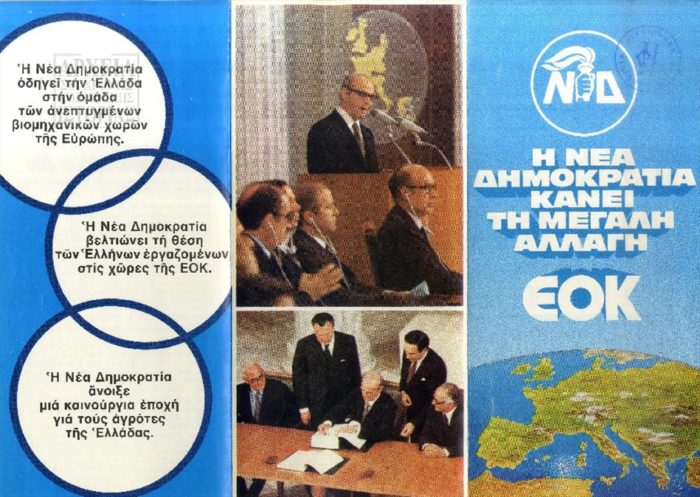
Οι διαπραγματεύσεις εισήλθαν στο τελικό τους στάδιο από τον Ιανουάριο του 1978 και μετά. Συνετέλεσε σ’ αυτό και το αποτέλεσμα των βουλευτικών εκλογών στην Ελλάδα καθώς οι εταίροι που υποστήριζαν την ένταξη της χώρας στην Ευρωπαϊκή Κοινότητα για πολιτικούς και στρατηγικούς λόγους συνειδητοποιούσαν ότι η άνοδος του ΠΑΣΟΚ δημιουργούσε μια νέα δυναμική, η οποία θα οδηγούσε σε ματαίωση της ενσωμάτωσης της χώρας αν οι διαπραγματεύσεις δεν ολοκληρώνονταν σύντομα. Παράλληλα, ο ελληνοτουρκικός διάλογος, που αναλήφθηκε σε επίπεδο κορυφής με τη συνάντηση Καραμανλή-Ecevit στο Μοντρέ της Ελβετίας, οδηγούσε τις σχέσεις των δύο χωρών σε ύφεση. Αυτό ήταν το πλαίσιο που οδήγησε στη συμφωνία για την ένταξη της Ελλάδας το Δεκέμβριο του 1978. Η προσαρμογή της ελληνικής γεωργίας και η ελεύθερη διακίνηση εργαζομένων στο χώρο της Κοινότητας θα υπόκειντο σε μεταβατικές περιόδους κατά περίπτωση πενταετούς ή επταετούς διαρκείας.
28 May 1979: The Signing of the Accession Treaty and Its Domestic Acceptance
What remained was to address the question of accession on the domestic political field. Papandreou and PASOK repeatedly called for a referendum. Karamanlis, by contrast, considered the parliamentary procedure sufficient and pointed out that the political forces supporting accession had represented a majority of the popular vote in the November 1977 elections.
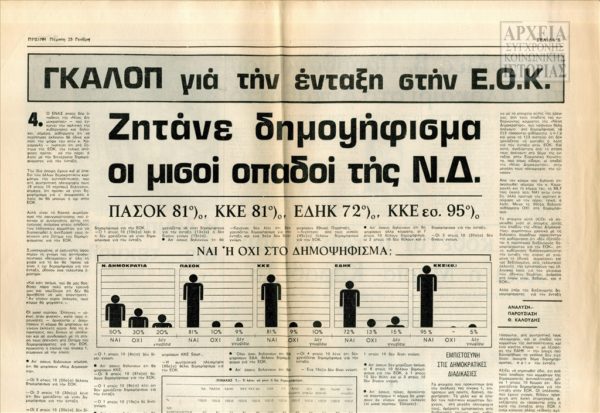 The Treaty was ratified in the summer of 1979, with 191 votes in favour and PASOK abstaining from the procedure. The electorate’s actual attitudes remain a matter of conjecture and cannot be established with certainty. The most reliable indicator available is the Eurobarometer survey from the period. According to its findings, there was a relative majority of respondents favourably disposed towards accession, although this did not exceed 40%, alongside a significant minority of around 25% and an intermediate body of voters who remained undecided.
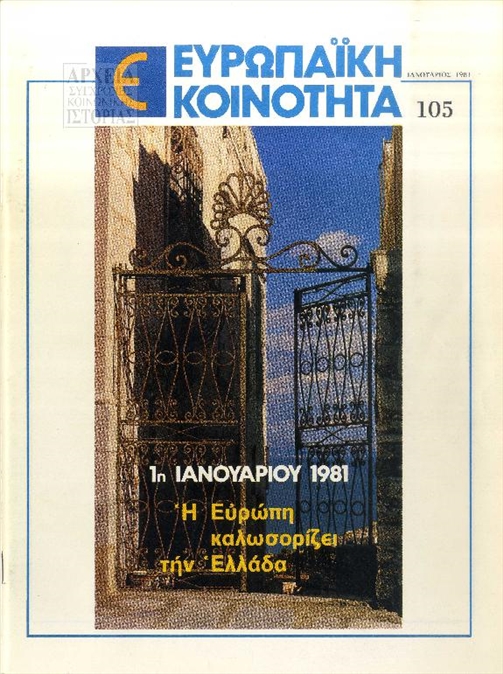
1 January 1981: Greece Joins the European Community
When the October 1981 elections took place, accession had already become a reality on 1 January. The result reflected party and political preferences, as well as the historical maturation of the demand to end the long period of conservative dominance, more than the electorate’s European orientation. It is telling, moreover, that the results of the European elections, held for the first time on the same day, revealed a different orientation among the electorate from that expressed in the national vote. The latter was nevertheless a “first-order” vote: it represented a primary and decisive political choice, whereas the European vote was a “second-order” vote, which reflected, albeit more loosely, attitudes and tendencies that tended to recede in elections that determined who would govern on the basis of strong political dilemmas.
When the October 1981 elections took place, accession had already become a reality on 1 January. The result reflected party and political preferences, as well as the historical maturation of the demand to end the long period of conservative dominance, more than the electorate’s European orientation. It is telling, moreover, that the results of the European elections, held for the first time on the same day, revealed a different orientation among the electorate from that expressed in the national vote. The latter was nevertheless a “first-order” vote: it represented a primary and decisive political choice, whereas the European vote was a “second-order” vote, which reflected, albeit more loosely, attitudes and tendencies that tended to recede in elections that determined who would govern on the basis of strong political dilemmas.
An initial conclusion that can be drawn from these first European elections concerning the electorate’s attitudes towards Europe is that the support for the two parties most explicitly opposed to accession, PASOK and the Communist Party of Greece (KKE), was a majority but considerably lower than their performance in the national elections held on the same day (53% compared with 60% in the national vote). This may indicate that opposition to the European Community was neither the primary nor the sole factor determining the vote for PASOK, and, at the same time, that attitudes towards the Community were neither cohesive nor immutable, but rather formed part of a broader spectrum of views. This interpretation is partly reinforced by the fact that a pro-European formation, the Communist Party of Greece–Interior, received considerably more votes than it had in the national elections. By contrast, the centrist Democratic Socialist Party benefited mainly from voters moving from New Democracy, but the overall result of the pro-European parties in the European ballot appeared to exceed their result in the national election.
With PASOK’s victory, the central problem facing Papandreou was how to manage the adjustment to the accomplished fact of accession. The government’s references to a referendum, a prerogative of the President of the Republic that would obviously not be exercised for as long as Karamanlis—the architect of accession—held the presidency, indicated that it did not intend to pursue the parliamentary procedure for withdrawal, despite the fact that PASOK and the KKE together commanded a three-fifths majority. The rhetoric was often sharp, but the actual policy consisted of a pragmatic adjustment and the securing of Community resources in order to put the issue to rest once and for all.
22 March 1982: Request for a Special Relationship with the European Community
In March 1982, the government submitted a memorandum requesting that the Community establish a special status for Greece. The request was rejected, but negotiations subsequently followed concerning the transfer of resources within the broader framework of the European Community’s enlargement towards Southern Europe.
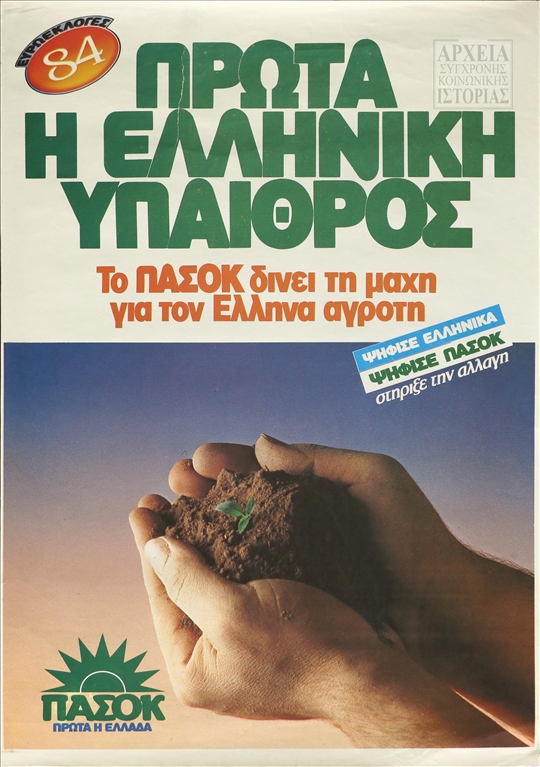
These discussions resulted in the Integrated Mediterranean Programmes, which, together with the Common Agricultural Policy—which proved considerably more generous than PASOK and Greek farmers themselves had previously anticipated—gradually settled the question of Greece’s accession. A specifically Greek form of Europeanism was now taking shape, based on economic benefit. From then on, Greece would participate in every stage of European integration on the basis of broad political consensus, with the sole exception of the KKE.
1 July 1987: The Conclusion of the Single European Act and the Establishment of the Single European Market
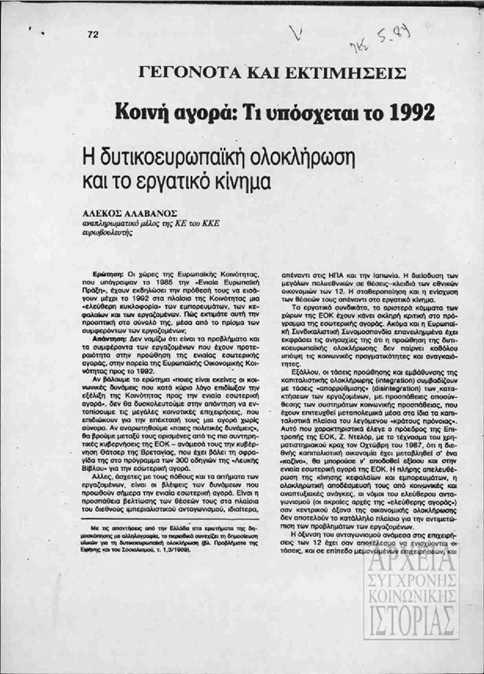
This is what happened in 1985–87, with the conclusion of the Single European Act. This marked the establishment, by the end of 1992, of a Single Market based on common rules, replacing the earlier Common Market, which had been characterised primarily by the common external tariff and the free movement of goods and workers. The Single Market represented something considerably more substantial: the creation of a unified European space in which people, goods and services could move freely on the basis of common rules, the implementation of which was overseen by Community institutions.
9–10 December 1991: The Maastricht Agreement on Monetary Union and the Adoption of a Common Currency
The next major step was Economic and Monetary Union, which paved the way for the adoption of a common currency, as provided for by the Maastricht Agreement of December 1991. Greek political thinking had consistently been shaped by the view that Greece’s participation in every stage of European integration was necessary for strategic reasons, namely to safeguard the country’s security. Moreover, from the mid-1980s onwards, the emerging economic crisis of the Soviet Union and the Eastern European People’s Republics, and ultimately the collapse of the Eastern bloc, suggested that Greece had found itself on the “right side” of History: within the zone of security and prosperity, and among the club of the wealthy.
 In any event, the transfer of resources constituted a significant incentive for Greece’s participation, as the funding for regional development, public works and the strengthening of economic sectors provided through successive Community Support Frameworks was on a scale far beyond the country’s domestic capacity. This did not remain without consequences, as the inflow of resources came to substitute for the pursuit of a development strategy and probably reinforced a strong tendency towards consumption. The result was low productivity, limited endogenous growth and an artificial prosperity sustained by public borrowing.
Tools