
Elias Nicolakopoulos
Emeritus Professor, National and Kapodistrian University of Athens
The consolidation of Democracy (1974–1981)
The first parliamentary elections after the fall of the military dictatorship (July 1974) were held on 17 November 1974 and implicitly, though unmistakably, took on the character of a plebiscite, providing a vote of confidence in the choices and responsibilities assumed by the political forces that had participated in the “Government of National Unity.” In the meantime, these political forces had rallied around New Democracy (ND) and the Centre Union–New Forces (EK-ND).
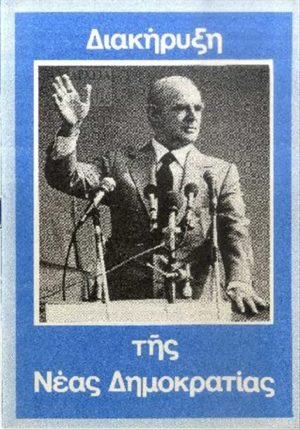
The ND was founded by Konstantinos Karamanlis in October 1974 and secured 54 per cent of the vote—an unprecedented achievement in post-war Greece—which guaranteed its absolute dominance in Parliament (216 out of a total of 300 seats). The governing party’s political choices moved in the direction of a controlled modernisation of the institutions.
Most of the political figures of the pre-dictatorship National Radical Union (ERE) had joined ND, as had a number of politicians who had left the Centre Union (EK) in the summer of 1965. At the same time, however, ND sought to renew its political personnel as broadly as possible and, owing to its electoral strength, 138 newly elected MPs appeared on the political scene for the first time. The expansion of ND’s electoral support in the 1974 elections, compared with the electoral influence of the pre-dictatorship ERE, bears certain similarities to de Gaulle’s rise to power in 1958. Indeed, ND displayed considerable electoral strength combined with a striking increase in its influence—compared with that of the pre-dictatorship ERE—among voters in working-class and popular neighbourhoods.
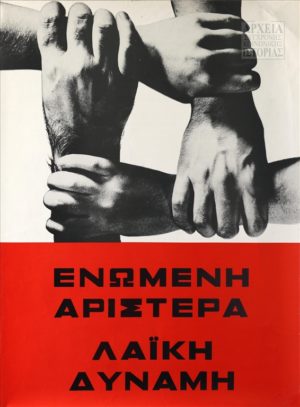
The EK-ND—under the leadership of Georgios Mavros (20.4 per cent of the vote and 61 seats), who had served as Deputy Prime Minister and Foreign Minister in the transitional government—showed clear signs of decline as a result of ND’s electoral success. Thus, although EK-ND emerged as the official opposition, the governing party’s overwhelming parliamentary dominance made it easier for EK-ND to draw closer to other opposition parties. Of these, the strongest was the newly founded Panhellenic Socialist Movement (PASOK), led by Andreas Papandreou (13.6 per cent of the vote and 15 seats), while the United Left party—a loose electoral coalition comprising the Communist Party of Greece (KKE), the KKE Interior and the United Democratic Left (EDA)—was limited to 9.5 per cent, the lowest electoral percentage achieved by the communist left since the Civil War. (1) At least during the initial stage of its formation, PASOK sought, and succeeded, in establishing the image of a completely new party, without direct links to the past. Its differentiation from the pre-dictatorship EK was particularly pronounced at the level of political discourse, but the similarities between the two parties were especially evident in terms of their electoral base and membership. (2)
On 8 December, a referendum was held on the future of the monarchy. The result was overwhelmingly in favour of a Republic, with 69.2 per cent voting for the abolition of the monarchy, while 30.8 per cent voted in favour of the monarchy. Thus, an issue that had been at the centre of the country’s public and political life since as early as 1915 was definitively resolved. It is therefore clear that the monarchy question no longer divided Greek public opinion. The electoral base of ND, as a conservative party, was itself divided by the outcome. Indeed, analysis of the referendum results reveals that almost all supporters of the monarchy came from the electoral base of the enlarged ND of 1974.
The policies pursued by ND after 1974 were characterised by a lack of boldness, particularly on issues of domestic politics concerning the dilemma of whether or not to break with the past. This approach affected the outcome of the next elections, held on 20 November 1977, when the party suffered significant losses on all fronts. The emergence of the National Alignment (6.3 per cent) as a rival force to the right of ND, together with the significant share of votes that shifted directly from ND to PASOK—a movement that may have involved as much as 9 per cent of the electorate and foreshadowed subsequent developments—dramatically reduced ND’s electoral strength from 54.4 per cent to 41.8 per cent, although the party retained an absolute parliamentary majority (171 seats).
The most important outcome of the 1977 elections, however, was the reconfiguration of the forces of the centre-left: PASOK almost doubled its electoral strength, reaching 25.3 per cent, and, with 93 seats, became the official opposition.
Όσον αφορά την αριστερή πτέρυγα του πολιτικού φάσματος, οι εκλογές του 1977 σφραγίστηκαν από την απόλυτη κυριαρχία του ΚΚΕ (9,4% και 11 έδρες) έναντι του κύριου αντίπαλόυ του, του ΚΚΕ Εσωτερικού. Έτσι έληξε η διαμάχη για την κληρονομιά της κομμουνιστικής εκλογικής παράδοσης, που υπήρχε από τη διάσπαση του ΚΚΕ το 1968.
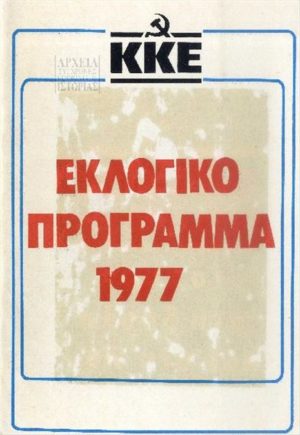
As for the left wing of the political spectrum, the 1977 elections were marked by the KKE’s absolute dominance (9.4 per cent and 11 seats) over its principal rival, the KKE Interior. This brought to an end the dispute over the legacy of the communist electoral tradition that had existed since the KKE split in 1968. According to many analysts, the configuration of political forces that emerged from the 1977 elections closely resembled a system of polarised pluralism, taking into account both the number of parties and the extent of political polarisation. (3) The multiparty system temporarily observed in the 1977 elections was subsequently rendered obsolete by the dissolution of the Union of the Democratic Centre (EDIK) following its electoral defeat. The political landscape that gradually emerged was one of a polarised and asymmetric three-party system. (4) Nicolakopoulos 1989. During the period 1978–1981, ND was able to deal without particular difficulty with the challenge emerging from its right—the National Alignment—and to avoid the creation of a division within the electorate between the Right and the Far Right. More specifically, the fact that the distinction between modernisation and attachment to tradition did not in any way coincide with the respective party choices of ND and the National Alignment facilitated the absorption of the Far Right. The latter had, in fact, penetrated deeply into ND itself, as had already become apparent in the 1974 referendum. This was demonstrated once again on several occasions during the 1978 local elections and was embodied, albeit somewhat ambiguously, in the conflict between Georgios Rallis and Evangelos Averoff over the succession to Konstantinos Karamanlis following the latter’s election as President of the Republic in May 1980.
The absorption of the Far Right by ND had the immediate consequence of making the latter appear as a continuation of the pre-dictatorship Right and thus distancing it from the political centre of electoral competition. (5) This significantly reduced and/or nullified the expected benefits of the party’s opening to the centre, undertaken in 1978 by attracting a substantial number of political figures from the Centre—for example, Konstantinos Mitsotakis from the Party of New Liberals and Athanasios Kanellopoulos from EDIK. This development enabled PASOK to move swiftly and occupy the centre of the political spectrum.
------------------------------------------------------(1) H. R. Penniman, (επιμ.), Greece at the Polls. The National Elections of 1974 and 1977, Washington and London: American Enterprise Institute, 1981, R. Clogg, Parties and Elections in Greece. The Search for Legitimacy, London: C. Hurst and Co, 1987.
(2) Ch. Lyrintzis, «Between Socialism and Populism: The Rise of the Panhellenic Socialist Movement», PhD dissertation, University of London, 1984, M. Spoudalakis, The Rise of the Greek Socialist Party, London: Routledge, 1988.
(3) S. Seferiades, «Polarization and Non-proportionality: The Greek Party System in the Postwar Era», Comparative Politics, 19:1, 69-93, 1986.
(4) G. Th. Mavrogordatos, «The Greek Party System: A Case of Limited but Polarized Pluralism?», West European Politics, 7:4, 156-169, 1984, Η. Νικολακόπουλος, Εισαγωγή στη θεωρία και την πρακτική των εκλογικών συστημάτων, Αθήνα και Κομοτηνή: Αντώνης Σάκκουλας, 1989.
(5) G. Th. Mavrogordatos, The Rise of the Greek Sun. The Greek Election of 1981, London: King’s College Press, 1983.
The Eight-Year Period of Andreas Papandreou (1981–1989)
In the next parliamentary elections, held on 18 October 1981, PASOK prevailed with 48.1 per cent of the vote (172 seats), leaving New Democracy (ND)—led by Georgios Rallis, who had been Prime Minister since May 1980—with 35.9 per cent (115 seats). The rapid changes that had taken place in the political system following the 1977 elections had contributed significantly to this outcome.
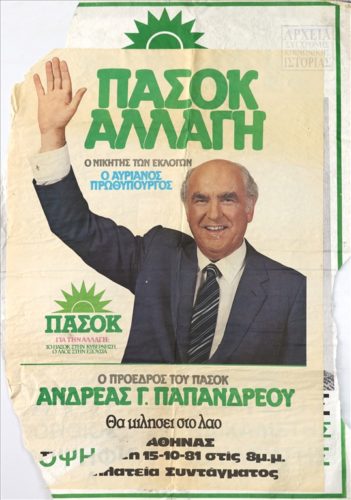
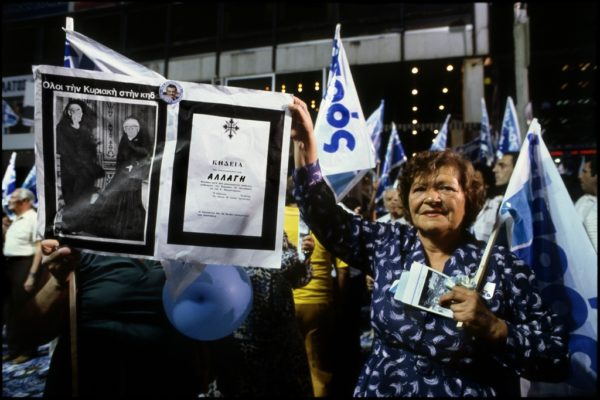
The electoral victory of PASOK was primarily due to the almost complete absorption of the electoral base situated to the left of the Union of the Democratic Centre (EDIK), resulting in a doubling of the electoral base of Andreas Papandreou’s party. At the same time, there was a striking transfer of voters from ND to PASOK, which may be estimated to have exceeded 10 per cent of the total electorate. The Communist Party of Greece (KKE) was the third-largest party, with a modest increase in its electoral strength (10.9 per cent and 13 seats), while no other party managed to gain parliamentary representation. The KKE Interior was reduced to 1.34 per cent, although it secured 5.29 per cent in the European Parliament elections held on the same day. It can therefore safely be argued that the 1981 elections marked a turning point in the formation and consolidation of an exclusively three-party system: the three parties represented in Parliament together accounted for 95 per cent of the vote, making the system to some extent comparable to the three-party system of the 1960s. (6)
PASOK succeeded in absorbing most of the traditionally centrist political space. The most characteristic example was its dominance in its stronghold of Crete, where it received 60.6 per cent of the vote overall, as well as in the north-western Peloponnese, where PASOK exceeded 50 per cent. Nevertheless, despite PASOK’s direct historical continuity with the pre-dictatorship Centre Union (EK), several important differences should be noted. First, there was a clear differentiation in PASOK’s social base. For example, its support exceeded 50 per cent of voters in the working-class and popular municipalities of the capital region, while remaining at approximately 35 per cent in middle- and upper-class suburbs. Second, there was a radical renewal of its political personnel. During this first post-dictatorship period, PASOK drew its parliamentary support primarily from the left wing that had emerged within the pre-dictatorship EK—particularly after the political crisis of 1965—and, above all, from figures who had come to prominence through the youth organisation of the Centre Union, the Greek Democratic Youth (EDIN). To a considerable extent, these figures also represented the radicalisation of the dynamically expanding younger social strata. For this reason, PASOK’s political discourse during the 1980s, particularly in its populist version, was characterised by continual references to the political crises of the 1960s. The formation of a socialist party—in its specifically Greek version—was therefore carried out by political figures who, to a considerable extent, had no previous parliamentary experience. Of the 170 MPs elected by PASOK in 1981, 150 were elected for the first time after the dictatorship and entered Parliament with PASOK. They were also remarkably young: two-thirds of PASOK’s first parliamentary group were under the age of 50.
ND, with its lowest share of the vote in parliamentary elections in its history up to that point, appeared to be returning to the electoral profile of the traditional pre-dictatorship Right. The clearest indication of this return was the considerable discrepancy in its electoral influence between rural areas, where it secured 39.5 per cent of the vote, and urban centres, where it was limited to 30.9 per cent. An immediate consequence of this difference was the exceptionally high proportion of pre-dictatorship MPs within ND’s parliamentary group, at approximately 30 per cent. This image was further reinforced by the change of leadership attempted in the aftermath of its electoral defeat, when Evangelos Averoff succeeded Rallis.
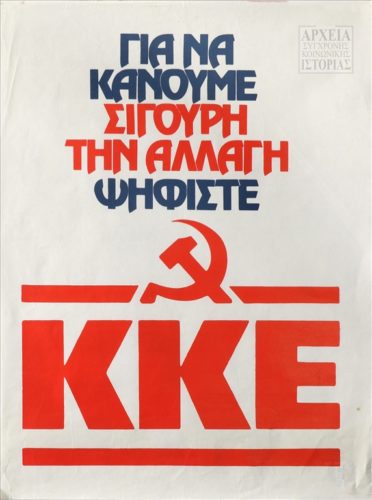
By contrast, the KKE, continuing its upward trajectory, tended to approach the electoral percentages achieved by the pre-dictatorship EDA, while the geographical distribution of its electoral strength remained, to a considerable extent, unchanged, either from that of the first years after the Civil War or even from that of the interwar period. For example, it is characteristic of this long-term historical continuity that, apart from the Athens and Thessaloniki areas, the KKE elected MPs in only three constituencies—Larissa, Magnesia and Lesbos—where, since the interwar period, it had enjoyed a solid and broad base of support that had provided it with parliamentary representation. (7)
The political system was consolidated to a significant degree by the change of government that took place in October 1981. At the same time, the measures adopted by the first PASOK governments—on the one hand ensuring income redistribution and, on the other, contributing directly or indirectly to eliminating the consequences of the Civil War—facilitated the incorporation of significant sections of the electorate into the political system and undermined the foundations of inherited divisions from the past. It should be emphasised that these changes were undertaken within the context of the continuous strengthening of a populist-type political current.
During its first four years in office, PASOK’s principal concern was to maintain its dominance within the political system. On the one hand, it sought a favourable—for itself—merger of the conflicts of the past into a simplified form, symbolically condensed in the confrontation between the “Right and Anti-Right”; on the other, through tactical political manoeuvres, it periodically brought this distinction back to the forefront. The most characteristic example of this strategy was the so-called “break of 9 March 1985”, which brought an end to the coexistence of the President of the Republic—an office held by Konstantinos Karamanlis during the period 1980–1985—with a government originating from a different political and party milieu.
The parliamentary elections of 2 June 1985 confirmed PASOK’s tactical choices, securing the party a second four-year term in government with 45.8 per cent of the vote (161 seats), despite the relative rise of ND (40.8 per cent and 126 seats), which had been led by Konstantinos Mitsotakis since September 1984. The most important feature of the 1985 elections was the combination of the three-party division of the electorate with an especially intense bipolar form of both electoral and governmental competition—the “conflict between two worlds”.
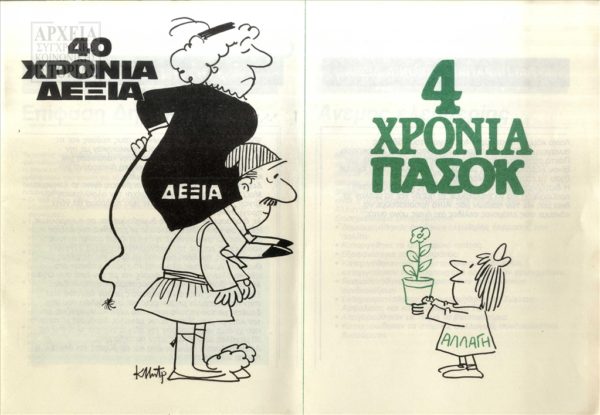
Bipolarisation also generated significant cross-fertilisation and fluidity between the two anti-Right poles of the three-party system, PASOK and the KKE. As an empirical study of this period demonstrates, almost half of the electoral base of the communist Left viewed PASOK favourably, while at the same time a significant proportion of PASOK supporters viewed both the KKE and the KKE Interior favourably. Beyond these party affiliations, perhaps the most decisive factor was the relatively common ideological composition of the electoral bases of the two anti-Right political forces. Their principal ideological reference points included opposition to the United States, to representatives of capital, and to the experience of the post-Civil War “state of the Right”. Combined with the outright rejection of ND, this provided the real basis for consolidating the schematic conflict between the “Right and Anti-Right”. (8)
The 1985 elections did not significantly alter the electoral map, but they confirmed several crucial concentrations of electoral support for PASOK, ND and the KKE. Compared with the 1981 elections, ND substantially increased its influence in urban centres, from 30.9 to 38.7 per cent. It did not, however, manage to increase its electoral gains significantly in rural constituencies, where it received 42.5 per cent, compared with 39.5 per cent in 1981. These gains can be explained almost entirely by the contraction of the Far Right and the absorption of some remnants of the centre-right.
By contrast, PASOK largely maintained its influence in rural areas, receiving 46.5 per cent compared with 48 per cent in 1981, but experienced a significant decline in the urban centres, from 48.2 to 44.9 per cent, with the losses concentrated mainly among the middle and upper social strata. PASOK’s decline in the urban centres would have been even greater had it not been partly offset by some limited but notable gains among lower social strata that had supported the KKE in previous elections. Indeed, while the KKE’s electoral influence in rural constituencies remained stable (8.2 per cent in 1985 compared with 8.3 per cent in 1981), it experienced a significant decline in urban centres (12.2 per cent, compared with 14.6 per cent in 1981), including in areas that had until then been regarded as its strongholds. This development led the KKE to conclude that “the matrix of the EAM resistance is exhausting its potential to support our party” and to decide to undermine the framework of confrontation between the “Right and Anti-Right”. (9)
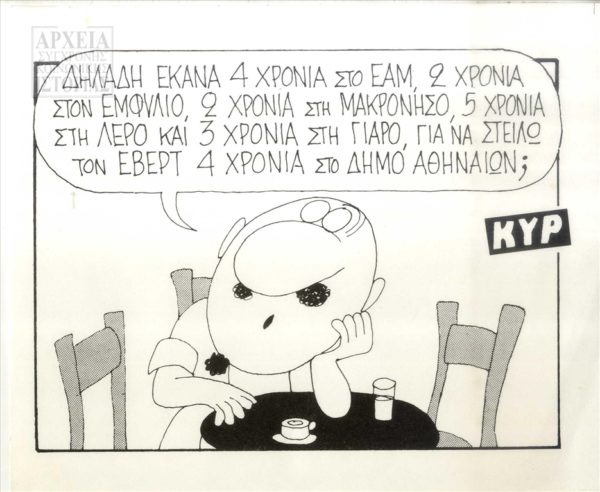
At the same time, ND began to recognise that the ideological use of history was now working primarily to PASOK’s advantage. PASOK had succeeded in establishing the confrontation between the “Right and Anti-Right” as the dominant interpretation of history, one that posed numerous dilemmas. This was, of course, an electorally advantageous synthesis for PASOK of the multiple conflicts of the past. Thus, from early 1986 onwards, ND sought to neutralise the political significance of these inherited divisions and to foreground the goal of “national reconciliation”. Specifically, it adopted an approach to political competition radically different from that which it had previously pursued—an approach that had culminated in its withdrawal from Parliament in August 1982, when EAM resistance was recognised for the first time. These new choices were tested with unexpected success in the local elections of October 1986, when ND candidates were elected in the country’s three largest municipalities—Athens, Piraeus and Thessaloniki—where the forces of the centre-left had until then prevailed. The 1986 local elections also witnessed changes in the KKE’s electoral strategy: it refused to support the PASOK candidate in Athens in the second-round run-off, thereby symbolically expressing its opposition to the logic of the “Right and Anti-Right” confrontation adopted by PASOK.
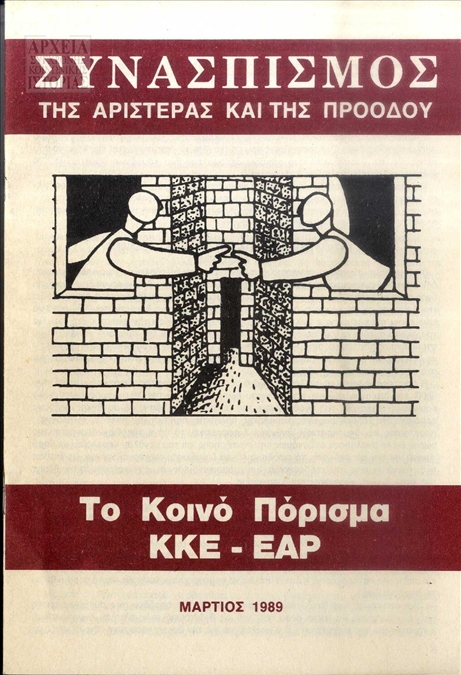
These developments, which revealed the limits of the historical orientation of political identities, formed part of a broader transformation of political life that took place during PASOK’s second term in government. Beginning with the stabilisation programme of 1985—which imposed fiscal austerity measures—and the subsequent crisis in the labour movement, PASOK’s influence declined steadily from 1986 onwards. At the same time, the party lost contact with groups affiliated with both the Right and the Left. Its capacity to appeal across different social and political constituencies had begun to decline, while the public image of its leader no longer enjoyed the broad appeal of the past. The latter trend became even more pronounced following Andreas Papandreou’s illness in the summer of 1988 and the scandals that came to light during the same period. Despite the markedly negative climate that had developed around PASOK, particularly towards the end of 1988, the other parties did not appear capable of absorbing this discontent in the immediate period that followed. ND failed to convince undecided voters sufficiently either of its capacity to govern or of the modernisation of its political image. At the same time, in February 1989, the KKE and the Greek Left (EAR)—as the KKE Interior was now called—formed the Coalition of the Left and Progress.
Despite the enthusiasm this generated within the Left, the Coalition was confronted with the crisis of “actually existing socialism”, a circumstance that limited its political appeal. (10)
Developments leading up to the parliamentary elections of 18 June 1989 revealed the extent of the institutional crisis and the crisis of the political system, as well as the enormous difficulties involved in overcoming it. The establishment of a system of proportional representation in the spring of 1989 naturally created the institutional conditions for the formation of coalition governments. Nevertheless, the necessary political convergence for such an outcome was absent. For this reason, proportional representation could not function as a catalyst for reforming the political system and ensuring the harmonious functioning of its institutions. The principal obstacle was the gradually widening gap between supporters of PASOK and those of the Coalition, which was intensified by the political circumstances that emerged as a result of the “scandals” and the campaign of “cleansing from corruption”. Thus, on the eve of the June 1989 elections, the majority of Coalition supporters viewed PASOK in entirely negative terms, almost as negatively as they viewed ND. Consequently, the traditional three-party system lost one of its most important characteristics: the bipolar conflict between the “Right and Anti-Right”. (11)
(6) Η. Νικολακόπουλος, Άτλας των Βουλευτικών Εκλογών της 18ης Οκτωβρίου 1981, Αθήνα: ΕΚΚΕ, 1984, K. Featherstone, D. Katsoulas (επιμ.), Political Change in Greece: Before and After the Colonels, London: Croom Helm, 1985.
(7) Η. Νικολακόπουλος, Άτλας των Βουλευτικών Εκλογών.., όπ. π.
(8) Χ. Λυριντζής, Η. Νικολακόπουλος (επιμ.), Εκλογές και κόμματα στη δεκαετία του ’80. Εξελίξεις και προοπτικές του πολιτικού συστήματος, Αθήνα: Θεμέλιο, 1990.
(9) Χ. Λυριντζής, Η. Νικολακόπουλος (επιμ.), όπ. π., σ. 212.
(10) Γ. Βούλγαρης, Η Ελλάδα της μεταπολίτευσης 1974-1990. Σταθερή δημοκρατία σημαδεμένη από τη μεταπολεμική ιστορία, Αθήνα: Θεμέλιο, 2002.
(11) Χ. Λυριντζής, Η. Νικολακόπουλος (επιμ.), όπ. π.
The Crisis Elections (1989–1990)
The electoral result of 18 June 1989 bore the imprint of the trends that had taken shape during the four-year period from 1985 to 1989. New Democracy (ND) emerged as the largest party, with 44.3 per cent of the vote (145 seats), but failed to secure an absolute parliamentary majority. Rallying a large part of its electoral base, PASOK came second with 39.1 per cent (125 seats), despite the departure of several prominent figures from the party, including Gerasimos Arsenis. The significant rise of the Coalition of the Left and Progress, which secured 13.1 per cent (28 seats)—the highest percentage achieved by the communist Left since 1974—made the Left a decisive factor in securing a parliamentary majority.
As in the previous elections, ND's rise in the elections of 18 June was greater in the urban centres, where it increased its support by 4 per cent compared with 1985. It did not, however, manage to attract even half of PASOK's losses, which amounted to an 8.5 per cent decline compared with 1985; a significant share of these losses was absorbed either by the Coalition or by smaller parties. The rise of ND and the corresponding decline of PASOK derived primarily from the middle social strata of the urban centres, and particularly from their more dynamic subgroups. Among the lower social strata, however, the decline in PASOK's strength was considerably smaller. The overall effect of these changes was to reinforce the pronounced social differentiation that had already begun to emerge within PASOK's electoral base in 1985: in June 1989, its support stood at approximately 45 per cent among the lower social strata, 35 per cent among the middle strata, and around 25 per cent among the upper strata.
The coalition government formed by ND and the Coalition, with Tzannis Tzannetakis as Prime Minister, was neither a prearranged choice nor should the June result be regarded as providing a clear mandate in any particular direction. To a considerable extent, it was the unexpected outcome of the electoral contest and the culmination of the changes that had taken place within the parties' electoral bases. It is characteristic that, on the basis of the pre-election opinion polls of the period, it could be argued that Greek public opinion conformed to the Condorcet paradox: a government led by ND was preferable to a PASOK government, a PASOK government was preferable to a Coalition government, and a Coalition government was preferable to an ND government. Regardless of the political choices made at the leadership level, the convergence of the Left and the Right in the formation of the Tzannetakis government was made possible, on the one hand, by the deep rift created by the dividing line between the “Right and Anti-Right” and, on the other, by the particular importance attached to the issue of “cleansing” political life. (12)
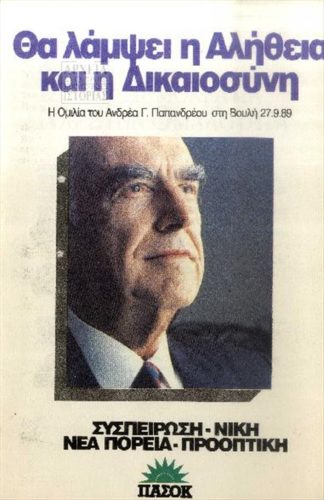
In the next elections, held on 5 November 1989, the coalition government between ND and the Coalition, as well as the crucial political decision in favour of judicially resolving the scandals—including the criminal prosecution of Andreas Papandreou—were at the centre of the political contest. The result of these elections revealed that, from an electoral standpoint, the issue of “cleansing” had already been decided the previous June. Consequently, little could now change with regard to the electorate's political preferences. PASOK, although on the defensive, succeeded in rallying most of its supporters and increased its strength to 40.7 per cent, winning 128 seats, compared with 39.1 per cent in June. ND, despite its continued rise—from 44.3 to 46.2 per cent—again failed to secure a governing majority in Parliament, remaining at 148 seats and no longer having the possibility of forming further alliances. Thus, only the Coalition experienced an electoral decline, falling to 11.0 per cent and 21 seats, as its unforeseen political choices during the summer of 1989 had shaken the already fragile historical and social cohesion of the electoral base of the communist Left.
The Coalition's losses were a generalised phenomenon, but they acquired particular significance because in many cases they were accompanied by clear social differentiation and because they were substantial among the lower social strata. Consequently, the strength of the communist Left, particularly among working-class voters in the capital, reached its lowest levels since the Civil War in November 1989. These losses suffered by the Coalition enabled PASOK to make gains and offset its losses to ND, particularly in rural constituencies and among the middle strata.
The political developments following November 1989 produced further surprises comparable to those of the preceding three-month period. The formation of the “Ecumenical” Government, with Xenophon Zolotas as Prime Minister and the participation of ND, PASOK and the Coalition—another unprecedented event in the country's post-war history—moderated the intense polarisation that had prevailed and substantially blurred the “dividing lines” that had sustained it. The critical problems of the economy became the government's foremost priority, while at the same time the Ecumenical Government repeatedly disappointed the hopes it had generated for resolving the crisis. The dilemma of “government or lack of government”, which had been ND's central electoral slogan, was reinforced by the prolonged governmental and political instability. At the same time, a rapprochement between PASOK and the Coalition proved impossible because of hesitation and mutual reservations, thereby undermining the prospect of an alternative coalition government formed by the two parties as an alternative to a single-party ND government.
The deadlock that arose during the election of the President of the Republic, triggered by ND, led to a third election within less than a year, held on 8 April 1990. Although electoral shifts compared with November were very limited—only three or four out of every 100 voters switched their vote to another party—ND managed to increase its support slightly, reaching 46.9 per cent and 150 seats. It eventually secured a governing majority when the sole MP elected by Democratic Renewal (DIANA) joined ND. DIANA was a group of politicians who had left ND after the 1985 elections, led by Kostis Stephanopoulos, who later became President of the Republic. ND's rise was due to its success in penetrating PASOK's political field while, at the same time, attracting a small but by no means negligible proportion of Coalition supporters, mainly from the middle and upper social strata of the capital. The latter would have been unthinkable in other periods, as it would have contradicted the stable process of political forces organizing into parties. It could therefore be regarded as an early symptom of the broad electoral fluidity that characterised the elections of the period that followed. (13)
PASOK's decline in June 1989, after eight years in government, and the shift in the balance of power in favour of ND should not be attributed exclusively to the process of the “normal” electoral wear and tear experienced by a party in office. It was the outcome of deeper social, economic and ideological realignments, which were shaped and influenced by the international climate of the 1980s, when liberalism or neoliberalism predominated in the West and “actually existing socialism” was collapsing. (14)
ND's dominance in the April 1990 elections was a consequence of these realignments. For this reason, the government formed under Konstantinos Mitsotakis enjoyed a period of grace, which left its mark on the Municipal elections that followed in October. Emboldened by its success, the ND government changed the electoral law and restored the reinforced proportional representation system of 1985, which allocated additional seats to the leading party. On the one hand, it introduced a “3 per cent threshold” into the electoral system, establishing the minimum percentage required for a party to gain parliamentary representation; on the other, it introduced a procedure that ensured respectable representation for small parties, with almost the same degree of proportionality as under the 1989–1990 system. The purpose of this arrangement was to prevent a possible alliance between PASOK and the Coalition.
In conclusion, it can be argued that the principal characteristics of the Third Hellenic Republic from 1974 to 1990 were the difficult but steady retreat from the inherited divisions of the past and the gradual reorientation of electoral competition among political parties towards contemporary issues and the political stakes of the present.
(12) Γ. Αναστασάκος, Γ. Βούλγαρης, Η. Νικολακόπουλος, «Εκλογές 1989-1990», ειδική έκδοση για Τα Νέα, 1990.
(13) Γ. Αναστασάκος, Γ. Βούλγαρης, Η. Νικολακόπουλος, όπ. π.
(14) Γ. Βούλγαρης, Η Ελλάδα της μεταπολίτευσης.., οπ. π.
Tools